










ARTHROPLASTY
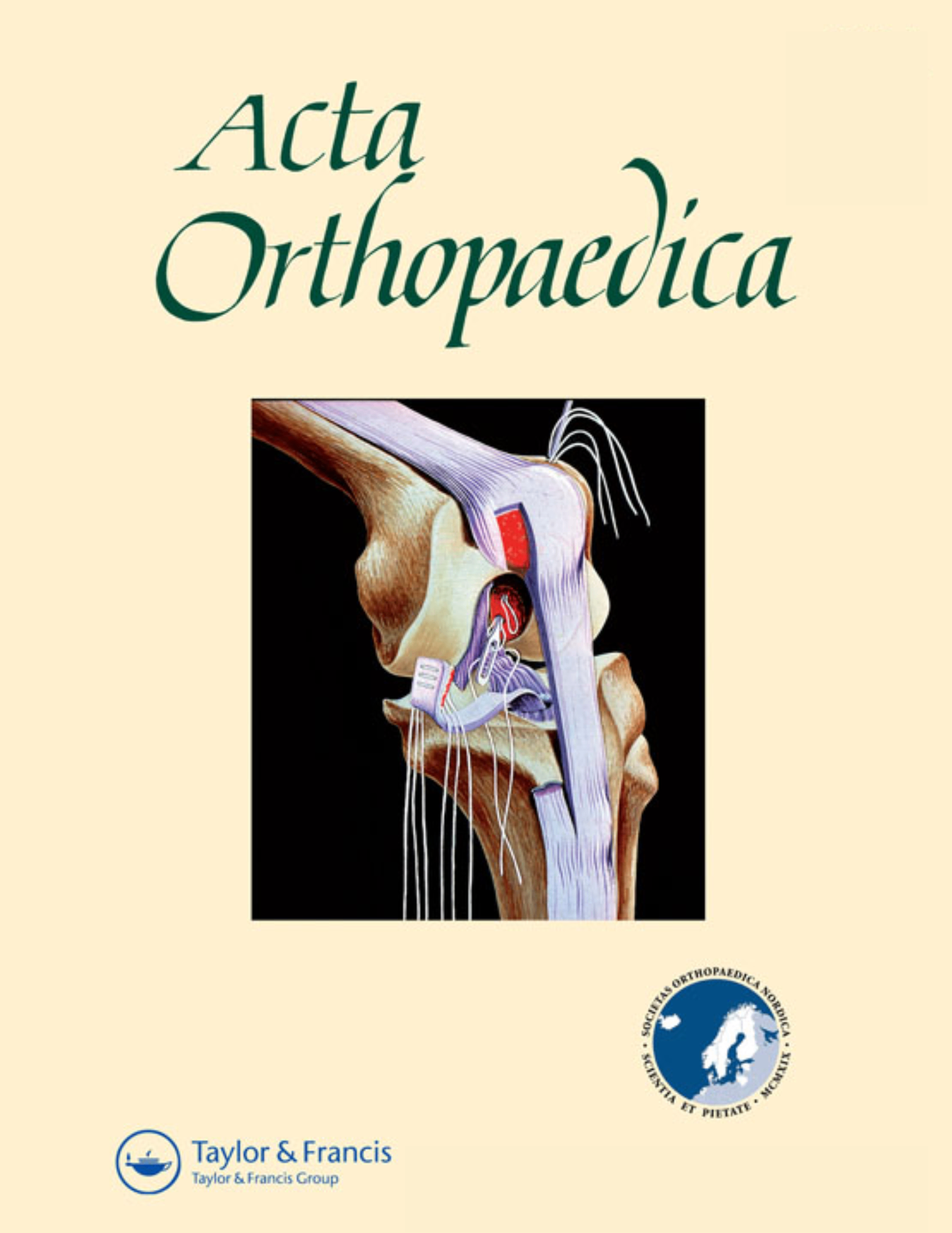
Migration and clinical outcome of mobile-bearing versus fixed-bearing single-radius total knee arthroplasty
 This report has been verified
by one or more authors of the
original publication.
This report has been verified
by one or more authors of the
original publication.
OrthoEvidence Journal (OE Journal) - ACE Report
OE Journal. 2018;6(11):6 Acta Orthop. 2018 Apr;89(2):190-19648 patients scheduled for total knee arthroplasty with a single radius implant were randomized to either a mobile-bearing or fixed-bearing design. Patients were primarily followed up for tibial component migration after 6 years. Secondary outcomes also included clinical scores and knee range of motion. Results demonstrated no significant differences between groups for any of the assessed outcome measures.
Was the allocation sequence adequately generated?
Was allocation adequately concealed?
Blinding Treatment Providers: Was knowledge of the allocated interventions adequately prevented?
Blinding Outcome Assessors: Was knowledge of the allocated interventions adequately prevented?
Blinding Patients: Was knowledge of the allocated interventions adequately prevented?
Was loss to follow-up (missing outcome data) infrequent?
Are reports of the study free of suggestion of selective outcome reporting?
Were outcomes objective, patient-important and assessed in a manner to limit bias (ie. duplicate assessors, Independent assessors)?
Was the sample size sufficiently large to assure a balance of prognosis and sufficiently large number of outcome events?
Was investigator expertise/experience with both treatment and control techniques likely the same (ie.were criteria for surgeon participation/expertise provided)?
Sì = 1
Incerto = 0,5
Non rilevante = 0
No = 0
La valutazione dei criteri di segnalazione valuta la trasparenza con cui gli autori riportano le caratteristiche metodologiche e sperimentali dello studio all'interno della pubblicazione. La valutazione è suddivisa in cinque categorie che vengono presentate di seguito.
1/4
Randomização
3/4
Medidas de resultado
0/4
Inclusão/Exclusão
2/4
Descrição do tratamento
3/5
Estatística
Detsky AS, Naylor CD, O'Rourke K, McGeer AJ, L'Abbé KA. J Clin Epidemiol. 1992;45:255-65
L'Indice di Fragilità è uno strumento che aiuta l'interpretazione dei risultati significativi, fornendo una misura della forza di un risultato. L'Indice di Fragilità rappresenta il numero di eventi consecutivi che devono essere aggiunti a un risultato dicotomico per rendere il risultato non più significativo. Un numero piccolo rappresenta un risultato più debole, mentre un numero grande rappresenta un risultato più forte.
Perché questo studio era necessario ora?
Many studies and analyses have been conducted comparing outcomes between mobile-bearing and fixed-bearing total knee implants. However, a number of these studies were completed using older implant designs, and may not reflect the comparative efficacy of newer designs. Furthermore, specific efficacy when considering single radius implants has not been thoroughly investigated previously.
Qual era la domanda di ricerca principale?
In single-radius total knee arthroplasty, is there a significant difference in mid-term (6-year) migration between a mobile-bearing implant and a fixed-bearing implant?
Quali erano i risultati importanti?
- Maximum total point motion at 6 years did not significantly differ between the MB group (1.22mm [95%CI 0.75-1.80]) and the FB group (0.90mm [95%CI 0.49-1.41]) (p=0.30).
- Change in range of knee flexion after 6 years did not significantly differ between the MB group and the FB group (p=0.2).
- Change in range of knee extension after 6 years did not significantly differ between the MB group and the FB group (p=0.2).
- Change in Knee Society Knee Scores after 6 years did not significantly differ between the MB group and the FB group (p=0.7).
- Change in Knee Society Function Scores after 6 years did not significantly differ between the MB group and the FB group (p=0.2).
- Revision due to aseptic loosening was performed in no patients of the MB group and 1 patient of the FB group. Revision due to septic loosening was performed in 1 patient of the MB group and 1 patients of the FB group.
- Recruitment was stopped early due to the investigation of one case of mobile bearing insert dislocation.
Che cosa devo ricordare di più?
In single-radius total knee arthroplasty, no significant differences in 6-year tibial migration, clinical outcome or revision rate were observed between cases completed using a mobile-bearing design and cases completed using a fixed-bearing design.
Come influenzerà l'assistenza ai miei pazienti?
The results of this study suggest that mid-term migration and clinical outcome is similar between mobile-bearing and fixed-bearing single-radius total knee implants. Therefore, it is unknown if there is any clear advantage of one design over the other.

DISCLAIMER
Il contenuto di questa pagina è solo a scopo informativo e non intende sostituire la consulenza, la diagnosi o il trattamento medico professionale. Se ha bisogno di cure mediche, si rivolga sempre al suo medico o al pronto soccorso più vicino. Le opinioni, le convinzioni e i punti di vista espressi dalle persone sui contenuti presenti in questa pagina non riflettono le opinioni, le convinzioni e i punti di vista di OrthoEvidence.
0 di 4 articoli mensili GRATUITI sbloccati



