




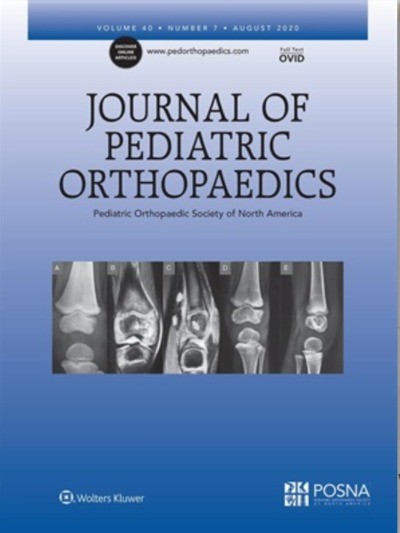






PEDIATRIC ORTHOPAEDICS
Comparison of Iliac and Femoral Autograft Practices in Pemberton Pelvic Osteotomy
OrthoEvidence Journal (OE Journal) - ACE Report
OE Journal. 2021;9(4):13 J Pediatr Orthop. 2021 Jan;41(1):46-50.Résumé de l'étude
Fifty patients (60 hips) aged >18 months to 6 years old with developmental dysplasia of the hip (DDH) scheduled for an open reduction, Pemberton pelvic osteotomy (PPO), and femoral shortening osteotomy were randomized to receive either iliac autograft (n=30 hips) or femoral autograft (n=30 hips) after PPO. Outcomes of interest included the following: acetabular index angle (AIA), time of surgery, mean blood loss, mean time to graft union, mean graft height and width, mean loss of graft height and width, and the incidence of complications (i.e. loss of graft position, graft resorption). AIA was evaluated at 1-day, 45-days, and 1-year post-surgery, whilst mean graft height, was assessed at 45-days and 1-year post-surgery. All other outcomes, excluding mean loss of graft height which was evaluated at 90-days follow-up, were measured peri-operatively. Results of this study demonstrated that the mean AIA, mean surgical time, and incidence of adverse events were not statistically significantly different between the two graft groups (p>0.05 for all). Furthermore, mean peri-operative graft width, mean graft height, mean loss of graft height, and mean blood loss were all statistically significantly in favour of the femoral autograft group (p<0.001 for all). Yet, mean time to graft union was statistically significantly in favour of the iliac autograft group (p=0.0001). Two patients experienced loss of graft position, and 1 patient experienced graft resorption. No cases of superficial/deep infections, neurovascular injury, or nonunion at the osteotomy line were observed in either group.
Débloquez le rapport complet du CAE
Vous avez accès à 4 plus d'articles GRATUITS ce mois-ci.
Cliquez ci-dessous pour déverrouiller et visionner ce ACE Reports
Déverrouillez maintenant
Évaluations critiques des derniers essais contrôlés randomisés à fort impact et des revues systématiques en orthopédie
Accès au contenu des podcasts OrthoEvidence, y compris les collaborations avec le Journal of Bone and Joint Surgery, les entretiens avec des chirurgiens de renommée internationale et les tables rondes sur l'actualité et les sujets orthopédiques.
Abonnement à The Pulse, une lettre d'information bihebdomadaire fondée sur des données probantes, conçue pour vous aider à prendre de meilleures décisions cliniques.
Accès exclusif à des articles au contenu original, y compris des revues systématiques internes et des articles sur les méthodes de recherche en santé et les sujets d'actualité en orthopédie.
Ou mettez votre compte à niveau dès aujourd'hui et accédez à tout le contenu d'OrthoEvidence pour seulement 1,99 $ par semaine.
Vous avez déjà un compte ? Se connecter
Vous êtes affilié à l'une de nos associations partenaires ?
Cliquez ici pour bénéficier d'un accès gratuit dans le cadre des avantages réservés aux membres de votre association !


Abonnez-vous à "Le pouls"
L'orthopédie fondée sur des données probantes directement dans votre boîte de réception. S'ABONNER
0 de 4 articles mensuels GRATUITS débloqués



