










SPORTS MEDICINE
Tunnel widening after ACL reconstruction with aperture screw fixation or all-inside reconstruction with suspensory cortical button fixation: Volumetric measurements on CT and MRI scans
OrthoEvidence Journal (OE Journal) - ACE Report
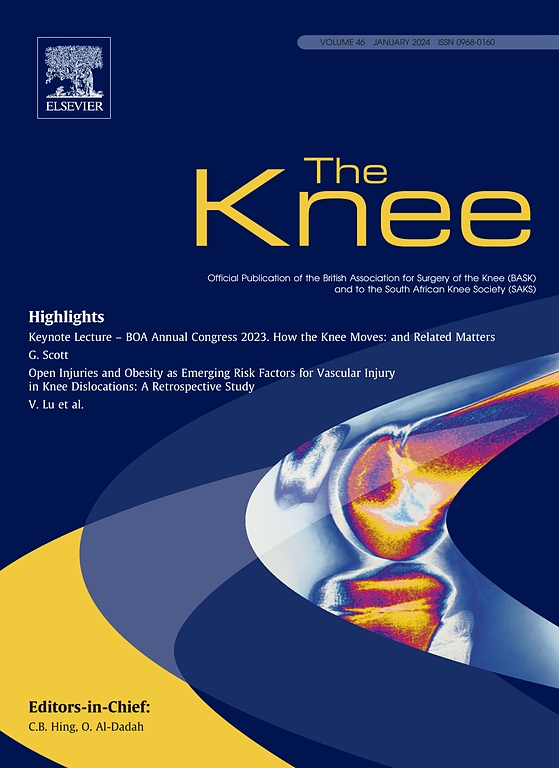
OE Journal. 2018;6(2):15 Knee. 2017 Oct;24(5):1047-105433 patients scheduled for ACL reconstruction were included in this study to compare the effects of different fixation methods on postoperative tunnel widening. Patients were randomized to reconstruction using aperture screw fixation or suspensory cortical button fixation. Tunnel volume was measured over a 6 month period using MRI and CT scans. The results at 6 months indicated no differences between the two groups for tibial tunnel volume (117.7+/-24.1% button group vs. 113.9+/-10.3% screw group (p=0.565)). While the femoral tunnel volume at 6 months was significantly greater in the button group (143.2+/-34.4%) compared to the screw group (119.8+/-19.2%) (p=0.023).
Was the allocation sequence adequately generated?
Was allocation adequately concealed?
Blinding Treatment Providers: Was knowledge of the allocated interventions adequately prevented?
Blinding Outcome Assessors: Was knowledge of the allocated interventions adequately prevented?
Blinding Patients: Was knowledge of the allocated interventions adequately prevented?
Was loss to follow-up (missing outcome data) infrequent?
Are reports of the study free of suggestion of selective outcome reporting?
Were outcomes objective, patient-important and assessed in a manner to limit bias (ie. duplicate assessors, Independent assessors)?
Was the sample size sufficiently large to assure a balance of prognosis and sufficiently large number of outcome events?
Was investigator expertise/experience with both treatment and control techniques likely the same (ie.were criteria for surgeon participation/expertise provided)?
Sí = 1
Incierto = 0,5
No relevante = 0
No = 0
La evaluación de los criterios de información evalúa la transparencia con la que los autores informan de las características metodológicas y del ensayo dentro de la publicación. La evaluación se divide en cinco categorías que se presentan a continuación.
4/4
Randomização
3/4
Medidas de resultado
4/4
Inclusão/Exclusão
4/4
Descrição do tratamento
4/5
Estatística
Detsky AS, Naylor CD, O'Rourke K, McGeer AJ, L'Abbé KA. J Clin Epidemiol. 1992;45:255-65
El Índice de Fragilidad es una herramienta que ayuda en la interpretación de hallazgos significativos, proporcionando una medida de fuerza para un resultado. El Índice de Fragilidad representa el número de eventos consecutivos que es necesario añadir a un resultado dicotómico para que el hallazgo deje de ser significativo. Un número pequeño representa un hallazgo más débil y un número grande un hallazgo más fuerte.
¿Por qué se necesitaba ahora este estudio?
Anterior cruciate ligament (ACL) reconstruction is often undergone following a tear. Various methods of graft fixation are available in these procedures. Recently, there has been an interest in whether the type of graft fixation used influences widening of either the femoral or tibial bone tunnels.
¿Cuál era la pregunta principal de la investigación?
In ACL reconstruction, does change in tunnel volume after 6 months significantly differ between graft fixation with bioabsorbable interference screws and suspensory extra-cortical button fixation?
¿Cuáles fueron los hallazgos importantes?
- On MRI, the percent change in tibial tunnel volume from baseline to 6 months did not significantly differ between the button group (96.4+/-19.0%) and the screw group (108.0+/-14.9%) (p=0.060). Similarly, on CT, the percent change in tibial tunnel volume from baseline to 6 months did not significantly differ between the button group (117.7+/-24.1%) and the screw group (113.9+/-10.3%) (p=0.565).
- On MRI, the percent change in femoral tunnel volume from baseline to 6 months was significantly greater in the button group (154.3+/-38.0%) compared to the screw groups (110.9+/-20.7%) (p<0.001). Similarly, on CT, the percent change in tibial tunnel volume from baseline to 6 months was significantly greater in the button group (143.2+/-34.4%) compared to the screw group (119.8+/-19.2%) (p=0.023).
¿Qué es lo que más debo recordar?
In ACL reconstruction, graft fixation with adjustable-length loop cortical buttons demonstrated significantly greater femoral tunnel volume increase within the first 6 months after surgery when compared to fixation with absorbable interference screws. Both types of fixation demonstrated similar degrees of tibial tunnel volume increase in the first 6 months after surgery.
¿Cómo afectará esto al cuidado de mis pacientes?
The results of this study suggest that short-term enlargement of the femoral tunnel may be larger with the use of an adjustable-length loop cortical button as opposed to a bioabsorbable interference screw in ACL reconstruction. Nevertheless, there is still considerable debate on the correlation between tunnel widening and clinical outcomes in these cases. Follow-up studies over the longer term are needed to determine if early tunnel enlargement is associated with latent complications after ACL reconstruction.

DESCARGO DE RESPONSABILIDAD
El contenido de esta página tiene únicamente fines informativos y no pretende sustituir el consejo, diagnóstico o tratamiento médico profesional. Si necesita tratamiento médico, busque siempre el consejo de su médico o acuda al servicio de urgencias más cercano. Las opiniones, creencias y puntos de vista expresados por las personas sobre el contenido que se encuentra en esta página no reflejan las opiniones, creencias y puntos de vista de OrthoEvidence.
0 de 4 artículos mensuales GRATIS desbloqueados



