










ARTHROPLASTY
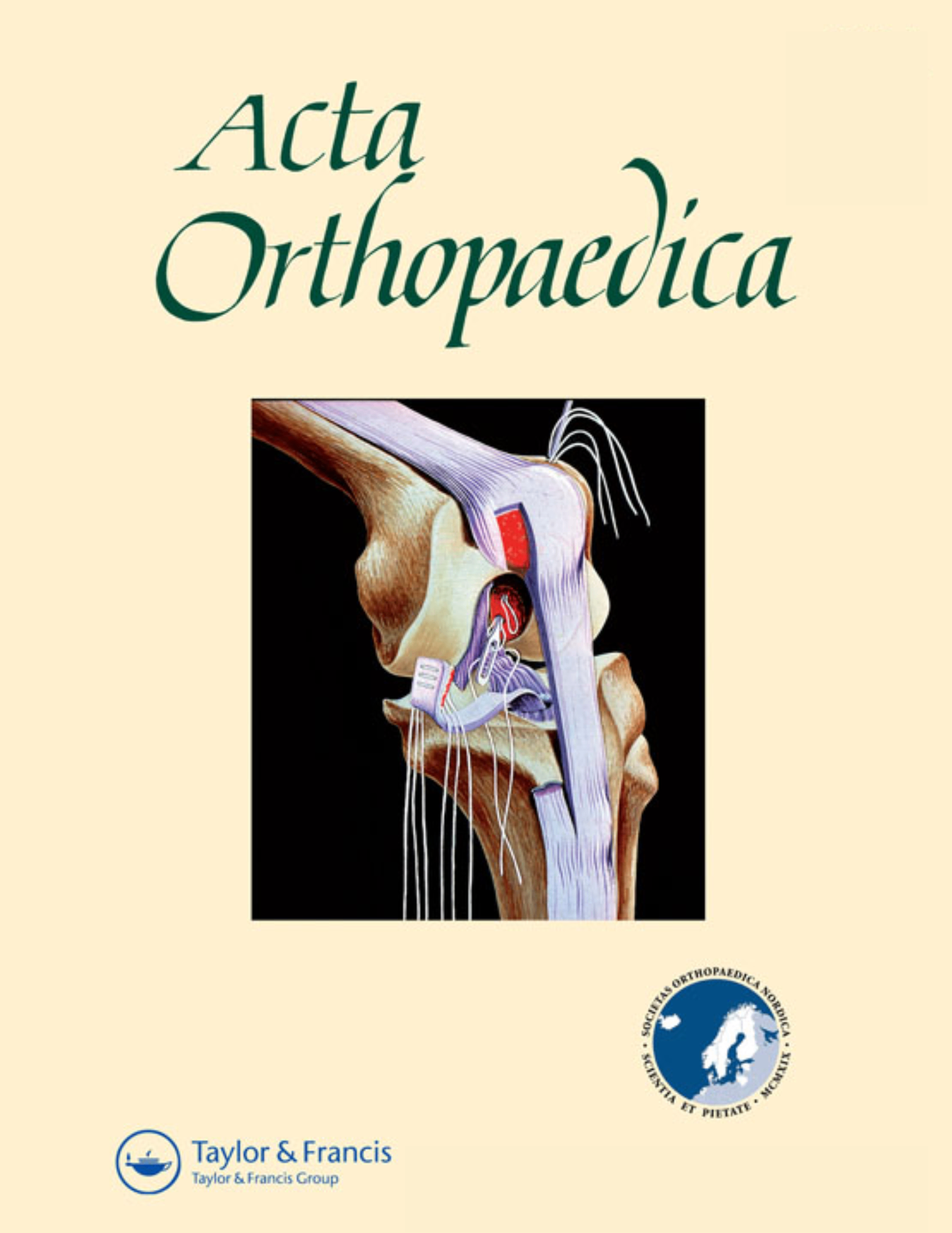
Patient-specific instrumentation does not improve radiographic alignment or clinical outcomes after total knee arthroplasty
 This report has been verified
by one or more authors of the
original publication.
This report has been verified
by one or more authors of the
original publication.
 Este estudio ha sido identificado como potencialmente de alto impacto.
La métrica de alto impacto de OE, impulsada por la IA, estima la influencia que probablemente tendrá un artículo integrando señales tanto de la revista en la que se publica como del contenido científico del propio artículo.
Desarrollado mediante el procesamiento del lenguaje natural más avanzado, el modelo de Alto Impacto de OE predice con mayor precisión el futuro rendimiento de las citas de un estudio que el factor de impacto de la revista por sí solo.
Esto permite reconocer antes las investigaciones clínicamente significativas y ayuda a los lectores a centrarse en los artículos con más probabilidades de configurar la práctica futura.
Este estudio ha sido identificado como potencialmente de alto impacto.
La métrica de alto impacto de OE, impulsada por la IA, estima la influencia que probablemente tendrá un artículo integrando señales tanto de la revista en la que se publica como del contenido científico del propio artículo.
Desarrollado mediante el procesamiento del lenguaje natural más avanzado, el modelo de Alto Impacto de OE predice con mayor precisión el futuro rendimiento de las citas de un estudio que el factor de impacto de la revista por sí solo.
Esto permite reconocer antes las investigaciones clínicamente significativas y ayuda a los lectores a centrarse en los artículos con más probabilidades de configurar la práctica futura.
OrthoEvidence Journal (OE Journal) - ACE Report
OE Journal. 2016;4(22):3 Acta Orthop. 2016 Aug;87(4):386-9421 studies evaluating the use of patient-specific instrumentation in total knee arthroplasty were included in this meta-analysis and systematic review. Pooled analyses demonstrated no significant difference between patient-specific instrumentation systems and conventional instruments in the incidence of excessive malalignment (>3 degrees deviation) in hip-knee-ankle angle. Additionally, the incidence of femoral component outliers in the coronal, sagittal, and axial planes, and tibial component outliers in the sagittal plane did not significantly differ, while tibial component outliers in the coronal plane occurred significantly more often with patient-specific instrumentation. No significant differences were found in short-term (3-month) clinical outcome measures. Two analyses which did favour patient-specific instrumentation were a lower number of surgical trays required during the procedure and shorter length of stay.
Were the search methods used to find evidence (original research) on the primary question or questions stated?
Was the search for evidence reasonably comprehensive?
Were the criteria used for deciding which studies to include in the overview reported?
Was the bias in the selection of studies avoided?
Were the criteria used for assessing the validity of the included studies reported?
Was the validity of all of the studies referred to in the text assessed with use of appropriate criteria (either in selecting the studies for inclusion or in analyzing the studies that were cited)?
Were the methods used to combine the findings of the relevant studies (to reach a conclusion) reported?
Were the findings of the relevant studies combined appropriately relative to the primary question that the overview addresses?
Were the conclusions made by the author or authors supported by the data and or analysis reported in the overview?
How would you rate the scientific quality of this evidence?
Sí = 1
Incierto = 0,5
No relevante = 0
No = 0
La evaluación de los criterios de información evalúa la transparencia con la que los autores informan de las características metodológicas y del ensayo dentro de la publicación. La evaluación se divide en cinco categorías que se presentan a continuación.
4/4
Introduction
4/4
Accessing Data
4/4
Analysing Data
4/4
Results
3/4
Discussion
Detsky AS, Naylor CD, O'Rourke K, McGeer AJ, L'Abbé KA. J Clin Epidemiol. 1992;45:255-65
El Índice de Fragilidad es una herramienta que ayuda en la interpretación de hallazgos significativos, proporcionando una medida de fuerza para un resultado. El Índice de Fragilidad representa el número de eventos consecutivos que es necesario añadir a un resultado dicotómico para que el hallazgo deje de ser significativo. Un número pequeño representa un hallazgo más débil y un número grande un hallazgo más fuerte.
¿Por qué se necesitaba ahora este estudio?
Patient-specific instrumentation (PSI) for component implantation in total knee arthroplasty is a recently-developed technology, with a number of randomized controlled trials performed investigating the systems of major orthopaedic device companies. PSI systems were designed to improve component alignment in these procedures, though conclusions on efficacy from previous studies vary widely. A synthesis of the literature was therefore needed to assess the current status of the role of PSI in TKA procedures.
¿Cuál era la pregunta principal de la investigación?
In total knee arthroplasty, are there any significant differences in radiographic alignment accuracy of component placement, perioperative parameters (blood loss, operative time, etc), and patient-reported outcome measures between patient-specific instrumentation and conventional instrumentation?
¿Cuáles fueron los hallazgos importantes?
- There was no significant difference in the incidence of outliers in hip-knee-ankle angle (>3deg deviation from neutral) overall between patient-specific and conventional instruments (13 studies; RR 1.02 [95%CI 0.82-1.27]; p=0.86), or when specific products (PSI-Zimmer, Signature-Biomet, TruMatch-DePuy, Visionaire-Smith & Nephew) were analyzed as subgroups (all p>0.05).
- There was no significant difference between groups in the incidence of femoral component outliers in the coronal plane (11 studies; RR 0.81 [95%CI 0.6-1.09]). The incidence of tibial component outliers in the coronal plane was significantly higher among patient specific groups (11 studies; RR 1.64 [95%CI 1.12-2.42]).
- There were no significant differences between groups in the incidence of outliers in the sagittal plane of either the femoral component (8 studies; RR 0.97 [95%CI 0.82-1.15]) or the tibial component (8 studies; RR 1.47 [95%CI 0.97-2.23]).
- There was no significant difference between groups in the incidence of femoral component rotational outliers (6 studies; RR 0.80 [95%CI 0.52-1.23]).
- No significant difference between patient-specific and conventional instrumentation groups was observed in operative time (12 studies; MD -0.90min [95%CI -4.78, 2.98]; p=0.65) or tourniquet time (3 studies; MD -6min [95%CI -21.2, 10.1]). No significant differences were observed in analyses of intra-, postoperative, and total perioperative blood loss.
- The length of hospital stay was shortened by 8 hours (95%CI 3.1-12.5) following the use of patient-specific instrumentation versus conventional instrumentation.
- Two studies demonstrated a significantly lower use of surgical trays (MD 4 trays [95%CI 2.58-5.61]) with patient-specific versus conventional instrumentation.
- No significant differences between groups were observed in patient-reported outcome measures at 3 months, including Knee Society Scores and Oxford Knee Scores.
¿Qué es lo que más debo recordar?
In total knee arthroplasty, the use of patient-specific instrumentation did not significantly reduce the incidence of malalignment overall, or of individual components in the coronal, sagittal, and axial planes. In fact, the incidence of tibial component outliers in the coronal plane was significantly higher following TKA with patient-specific instrumentation. No significant differences were observed in analyses of operative time, blood loss, or short-term clinical outcome. Advantages with the use of patient-specific instrumentation were noted concerning the number of surgical trays during the procedure, as well as in length of hospital stay.
¿Cómo afectará esto al cuidado de mis pacientes?
The results of this study suggest that there is no radiographic or clinical advantage to the use of patient-specific instrumentation in total knee arthroplasty, and in fact may compromise alignment of the tibial component. Benefits of patient-specific instrumentation appear limited to parameters of resource consumption, as evidenced by the analyses on surgical trays and the short, but significant, reduction in hospital stay. An economic analysis is needed to determine if these improvements in efficiency off-set the cost of the patient-specific instrumentation technology itself, as well as the preoperative imaging required to make the technology.

DESCARGO DE RESPONSABILIDAD
El contenido de esta página tiene únicamente fines informativos y no pretende sustituir el consejo, diagnóstico o tratamiento médico profesional. Si necesita tratamiento médico, busque siempre el consejo de su médico o acuda al servicio de urgencias más cercano. Las opiniones, creencias y puntos de vista expresados por las personas sobre el contenido que se encuentra en esta página no reflejan las opiniones, creencias y puntos de vista de OrthoEvidence.
0 de 4 artículos mensuales GRATIS desbloqueados



