










GENERAL ORTHOPAEDICS
A Randomized Trial Comparing Autologous Chondrocyte Implantation with Microfracture: Findings at Five Years
 Este estudo foi identificado como tendo um impacto potencialmente elevado.
A métrica de Alto Impacto da OE, baseada em IA, estima a influência que um artigo poderá ter, integrando sinais da revista em que foi publicado e do conteúdo científico do próprio artigo.
Desenvolvido com recurso ao mais avançado processamento de linguagem natural, o modelo High Impact da OE prevê com maior precisão o desempenho futuro de um estudo em termos de citações do que o fator de impacto da revista por si só.
Isto permite o reconhecimento precoce de investigação clinicamente significativa e ajuda os leitores a concentrarem-se nos artigos com maior probabilidade de moldar a prática futura.
Este estudo foi identificado como tendo um impacto potencialmente elevado.
A métrica de Alto Impacto da OE, baseada em IA, estima a influência que um artigo poderá ter, integrando sinais da revista em que foi publicado e do conteúdo científico do próprio artigo.
Desenvolvido com recurso ao mais avançado processamento de linguagem natural, o modelo High Impact da OE prevê com maior precisão o desempenho futuro de um estudo em termos de citações do que o fator de impacto da revista por si só.
Isto permite o reconhecimento precoce de investigação clinicamente significativa e ajuda os leitores a concentrarem-se nos artigos com maior probabilidade de moldar a prática futura.
OrthoEvidence Journal (OE Journal) - ACE Report
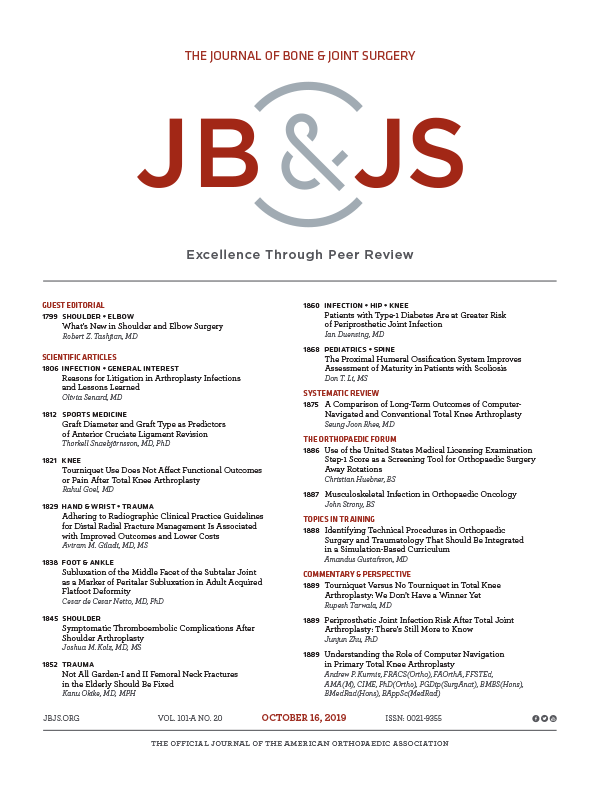
OE Journal. 2013;1(11):142 J Bone Joint Surg Am. 2007 Oct;89(10):2105-12This study was based on previous work completed by the same authors in 2004 which looked at the outcomes of autologous chondrocyte implantation and microfracture surgery at 2-year follow-up. This current study looks at outcomes at 5-year follow-up. 80 patients with a single chronic symptomatic cartilage defect on the femoral condyle were randomized to undergo one of two treatments. One group underwent an autologous chondrocyte implantation procedure while the other group underwent microfracture surgery. Results showed that clinical outcomes were comparable between the two groups. One-third of the patients showed radiographic signs of early osteoarthritis at the 5-year follow-up.
Was the allocation sequence adequately generated?
Was allocation adequately concealed?
Blinding Treatment Providers: Was knowledge of the allocated interventions adequately prevented?
Blinding Outcome Assessors: Was knowledge of the allocated interventions adequately prevented?
Blinding Patients: Was knowledge of the allocated interventions adequately prevented?
Was loss to follow-up (missing outcome data) infrequent?
Are reports of the study free of suggestion of selective outcome reporting?
Were outcomes objective, patient-important and assessed in a manner to limit bias (ie. duplicate assessors, Independent assessors)?
Was the sample size sufficiently large to assure a balance of prognosis and sufficiently large number of outcome events?
Was investigator expertise/experience with both treatment and control techniques likely the same (ie.were criteria for surgeon participation/expertise provided)?
Sim = 1
Incerto = 0,5
Não relevante = 0
Não = 0
A Avaliação dos Critérios de Relato avalia a transparência com que os autores relatam as caraterísticas metodológicas e do ensaio na publicação. A avaliação está dividida em cinco categorias que são apresentadas de seguida.
1/4
Randomization
3/4
Outcome Measurements
1/4
Inclusion / Exclusion
2/4
Therapy Description
4/4
Statistics
Detsky AS, Naylor CD, O'Rourke K, McGeer AJ, L'Abbé KA. J Clin Epidemiol. 1992;45:255-65
O Índice de Fragilidade é uma ferramenta que auxilia na interpretação de achados significativos, fornecendo uma medida de força para um resultado. O Índice de Fragilidade representa o número de eventos consecutivos que precisam de ser adicionados a um resultado dicotómico para que o resultado deixe de ser significativo. Um número pequeno representa um resultado mais fraco e um número grande representa um resultado mais forte.
Porque é que este estudo era necessário agora?
Autologous chondrocyte implantation and microfracture surgery are two procedures used in the treatment of cartilage lesions, but there is uncertainty on what is the best method for treatment. In 2004, the authors of this current study presented the results of these two methods of treatment at the 2-year follow-up. This study examines autologous chondrocyte implantation compared to microfracture surgery in the treatment of cartilage lesions at the 5-year follow-up.
Qual era a principal questão de investigação?
What are the clinical outcomes of performing autologous chondrocyte implantation compared to microfracture procedure on patients with a single chronic symptomatic cartilage defect on the femoral condyle at the 5-year follow-up?
Quais foram os resultados importantes?
- There were no significant differences seen between the two groups on the Lysholm score (p=0.227) and the VAS scores (p=0.278) at the 5-year follow-up.
- Both the implantation and microfracture group saw clinically significant improvements from preoperative measures at the 2 and 5-year follow-up.
- 72% of the patients in both groups saw an improvement in pain and 80% of the patients had better Lysholm scores from baseline at the 5-year follow-up. (p<0.05)
- At the 5-year follow-up, both groups saw 9 failures (23%) compared to the 2-year follow-up where the implantation group saw 2 failures and the microfracture group saw 1.
- Patients with the best-quality cartilage (mainly hyaline) examined at the 2-year follow up did not have any subsequent failures.
- No correlation was seen with histological quality and clinical outcomes.
- At the 5-year follow-up, 1/3 of the patients in each group showed radiographic evidence of early osteoarthritis.
De que é que me devo lembrar mais?
No significant differences were seen in clinical and radiographic outcomes between the autologous chondrocyte implantation group and the microfracture group at follow-up. 77% of patients in both groups saw satisfactory results. At the 5-year follow-up, 1/3 of the patients saw early radiographic signs of osteoarthritis. The study also proposed that microfracture surgery should be the first option for treatment due to it's minimally invasive and low-cost factors.
Como é que isto afectará o tratamento dos meus doentes?
Patients may not find any significant differences when undergoing autologous chondrocyte implantation or microfracture procedure in the treatment of cartilage lesions. Further studies are required to determine the long-term effects of both treatments as well as the progression of osteoarthritis.

AVISO LEGAL
O conteúdo desta página destina-se apenas a fins informativos e não pretende substituir o aconselhamento, diagnóstico ou tratamento médico profissional. Se necessitar de tratamento médico, procure sempre o conselho do seu médico ou dirija-se ao serviço de urgência mais próximo. As opiniões, crenças e pontos de vista expressos pelos indivíduos no conteúdo encontrado nesta página não reflectem as opiniões, crenças e pontos de vista da OrthoEvidence.
0 de 4 artigos mensais GRATUITOS desbloqueados



