










GENERAL ORTHOPAEDICS
Surgical versus nonsurgical treatment of acute minimally displaced and undisplaced scaphoid waist fractures: pairwise and network meta-analyses of randomized controlled trials
 This report has been verified
by one or more authors of the
original publication.
This report has been verified
by one or more authors of the
original publication.
 This study has been identified as potentially high impact.
OE's AI-driven High Impact metric estimates the influence a paper is likely to have by integrating signals from both the journal in which it is published and the scientific content of the article itself.
Developed using state-of-the-art natural language processing, the OE High Impact model more accurately predicts a study's future citation performance than journal impact factor alone.
This enables earlier recognition of clinically meaningful research and helps readers focus on articles most likely to shape future practice.
This study has been identified as potentially high impact.
OE's AI-driven High Impact metric estimates the influence a paper is likely to have by integrating signals from both the journal in which it is published and the scientific content of the article itself.
Developed using state-of-the-art natural language processing, the OE High Impact model more accurately predicts a study's future citation performance than journal impact factor alone.
This enables earlier recognition of clinically meaningful research and helps readers focus on articles most likely to shape future practice.
OrthoEvidence Journal (OE Journal) - ACE Report
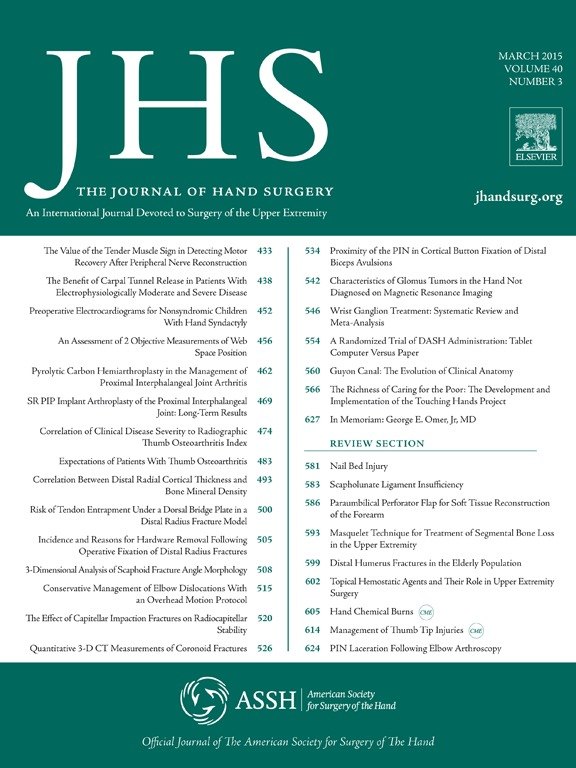
OE Journal. 2013;1(17):4 J Hand Surg Am. 2011 Nov;36(11):1759-1768.e1. doi: 10.1016/j.jhsa.2011.08.0336 studies (363 patients) examining outcomes of surgical and nonsurgical treatments of undisplaced or minimally displaced scaphoid waist fractures were evaluated through pairwise meta-analysis. An additional 3 trials were also identified for inclusion in a network meta-analysis. Following assessments of fracture union, complications, range of motion, grip strength, and osteoarthritis between patients who underwent either surgical or non-surgical treatment, there was a non-significant trend to increased union with surgical treatment. However this method of treatment was also associated with a higher risk of complications.
Were the search methods used to find evidence (original research) on the primary question or questions stated?
Was the search for evidence reasonably comprehensive?
Were the criteria used for deciding which studies to include in the overview reported?
Was the bias in the selection of studies avoided?
Were the criteria used for assessing the validity of the included studies reported?
Was the validity of all of the studies referred to in the text assessed with use of appropriate criteria (either in selecting the studies for inclusion or in analyzing the studies that were cited)?
Were the methods used to combine the findings of the relevant studies (to reach a conclusion) reported?
Were the findings of the relevant studies combined appropriately relative to the primary question that the overview addresses?
Were the conclusions made by the author or authors supported by the data and or analysis reported in the overview?
How would you rate the scientific quality of this evidence?
Yes = 1
Uncertain = 0.5
Not Relevant = 0
No = 0
The Reporting Criteria Assessment evaluates the transparency with which authors report the methodological and trial characteristics of the trial within the publication. The assessment is divided into five categories which are presented below.
4/4
Introduction
3/4
Accessing Data
4/4
Analysing Data
3/4
Results
3/4
Discussion
Detsky AS, Naylor CD, O'Rourke K, McGeer AJ, L'Abbé KA. J Clin Epidemiol. 1992;45:255-65
The Fragility Index is a tool that aids in the interpretation of significant findings, providing a measure of strength for a result. The Fragility Index represents the number of consecutive events that need to be added to a dichotomous outcome to make the finding no longer significant. A small number represents a weaker finding and a large number represents a stronger finding.
Why was this study needed now?
When scaphoid waist fractures occur they should be immobilized in order to allow for anatomical union and to prevent midcarpal arthrosis and carpal malalignment. Treatment can occur either surgically or non-surgically using a cast, but it is still unknown which method is the most effective. Hence, this meta-analysis aimed to compare the odds ratio of fracture union, complications, and other clinical outcomes of surgical and nonsurgical treatment of scaphoid waist fractures.
What was the principal research question?
Was surgical treatment of scaphoid waist fractures more effective than nonsurgical treatments, in terms of the odds ratio of fracture union?
What were the important findings?
- In the Pairwise meta-analysis there were 6 studies included (7 publications) that compared non –operative and operative treatment of scaphoid waist fractures. The Network meta-analysis identified another 3 randomized controlled trials that compared 2 non-surgical treatments resulting in a total of 9 trials comparing 5 different treatment methods.
- The Pairwise meta-analysis resulted in an overall pooled odds ratio of fracture union rate that was 2.36 (95% CI: 0.02, 8.9; p=0.210; I-squared: 0%). Although, the pooled odds ratio of fracture union rate was higher in the nonsurgical treatment patients (ratio: 3.10; 95% CI: 0.46, 21.05; p=0.250; I-squared: 0%) than in the surgical patients (ratio: 1.46; 95% CI: 0.11, 20.57; p=0.780; I-squared: 46.1%), this was not significant.
- The Pairwise meta-analysis of complication rate had a pooled odds ratio of 6.96 (95% CI: 2.13, 27.73; p=0.001; I-squared: 0%), which indicated an elevated risk of complication for those undergoing surgical treatment.
- Although the mean overall percentage difference in the range of motion (2.1%; 95% CI: -0.03, 0.08; p=0.430; I-squared: 61.4%) and grip strength (2.6%; 95% CI: -0.013, 0.066; p=0.190; I-squared: 0%) between the surgical and nonsurgical groups in the Pairwise Meta-analysis favoured surgery, these variations were not significant.
- The pooled odds ratios for osteoarthritis of the scaphotrapeziotrapezoid joint (3.25; 95% CI: 0.073, 14.39; p=0.120; I-squared: 65.4%) between the surgical and nonsurgical groups favoured surgery, while the pooled odds ratios for osteoarthritis of the radiocarpal joint (0.75; 95% CI: 0.15, 3.82; p=0.730; I-squared: 67.2%) between the surgical and nonsurgical groups favoured nonsurgery, these differences were not statistically significant.
- The Network meta-analysis assessed the odds ratio of fracture union for all possible pairwise comparisons. The results indicated that long and short thumb spica casts had the highest probability of being the best treatment (0.810). This was influenced by the lower number of non-unions in the solitary trial that compared these treatments.
What should I remember most?
Although the pair-wise analysis indicated a higher fraction union rate for the surgical treatment, this difference was not significant. Furthermore, surgical treatment appeared to have a higher risk of developing complications.
How will this affect the care of my patients?
Patients should be aware that there is a risk of developing complications by undergoing surgical treatment for scaphoid waist fractures. Although fracture union rates appeared to be higher with surgery in this study, this difference was not significant and there is no clear evidence indicating a significant increased union rates with surgery. Unless new evidence is released, then patients should continue to be treated using nonsurgical treatments.

DISCLAIMER
This content found on this page is for informational purposes only and is not intended to be a substitute for professional medical advice, diagnosis, or treatment. If you require medical treatment, always seek the advice of your physician or go to your nearest emergency department. The opinions, beliefs, and viewpoints expressed by the individuals on the content found on this page do not reflect the opinions, beliefs, and viewpoints of OrthoEvidence.
0 of 4 monthly FREE articles unlocked



