










METABOLIC DISORDERS
Randomized controlled trial of zoledronic acid for treatment of osteoporosis in women
OrthoEvidence Journal (OE Journal) - ACE Report
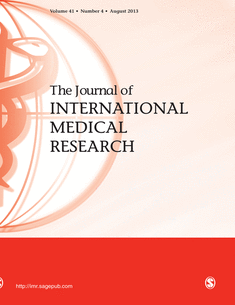
OE Journal. 2013;1(13):13 J Int Med Res. 2013 Jun;41(3):697-704. doi: 10.1177/0300060513480917. Epub 2013 May 13483 Chinese women with osteoporosis were randomized to receive one 5mg zoledronic acid (ZOL) intravenous infusion per year or a placebo. This two year study aimed to evaluate the effect of ZOL on fracture risk and bone mineral density. The results demonstrated increased bone mineral density in the total hip, femoral neck and trochanter with ZOL treatment. The overall risk of fracture was significantly reduced, compared to the placebo.
Was the allocation sequence adequately generated?
Was allocation adequately concealed?
Blinding Treatment Providers: Was knowledge of the allocated interventions adequately prevented?
Blinding Outcome Assessors: Was knowledge of the allocated interventions adequately prevented?
Blinding Patients: Was knowledge of the allocated interventions adequately prevented?
Was loss to follow-up (missing outcome data) infrequent?
Are reports of the study free of suggestion of selective outcome reporting?
Were outcomes objective, patient-important and assessed in a manner to limit bias (ie. duplicate assessors, Independent assessors)?
Was the sample size sufficiently large to assure a balance of prognosis and sufficiently large number of outcome events?
Was investigator expertise/experience with both treatment and control techniques likely the same (ie.were criteria for surgeon participation/expertise provided)?
Ja = 1
Ungewiss = 0.5
Nicht relevant = 0
Nein = 0
Die Bewertung der Berichtskriterien bewertet die Transparenz, mit der die Autoren die methodischen und studienspezifischen Merkmale der Studie in der Veröffentlichung angeben. Die Bewertung ist in fünf Kategorien unterteilt, die im Folgenden vorgestellt werden.
1/4
Randomization
3/4
Outcome Measurements
4/4
Inclusion / Exclusion
4/4
Therapy Description
3/4
Statistics
Detsky AS, Naylor CD, O'Rourke K, McGeer AJ, L'Abbé KA. J Clin Epidemiol. 1992;45:255-65
Der Fragilitätsindex ist ein Instrument, das bei der Interpretation signifikanter Ergebnisse hilft und ein Maß für die Stärke eines Ergebnisses liefert. Der Fragilitätsindex gibt die Anzahl der aufeinanderfolgenden Ereignisse an, die zu einem dichotomen Ergebnis hinzugefügt werden müssen, damit das Ergebnis nicht mehr signifikant ist. Eine kleine Zahl steht für ein schwächeres Ergebnis und eine große Zahl für ein stärkeres Ergebnis.
Warum wurde diese Studie jetzt benötigt?
Osteoporosis occurs in over 55% of the population over the age of 50 years. It compromises individual’s bone mineral density and exposes him or her to a higher risk of fractures. These fractures in the elderly can lead to increased morbidity, mortality and healthcare costs. Zoledronic acid, an aminobisphosphate, has shown positive effects on bone mineral density. This study was conducted to see if similar effects were present in mainland Chinese women.
Was war die wichtigste Forschungsfrage?
What is the effect of zoledronic acid (ZOL) on bone mineral density (BMD) and fracture risk at the L1-L4 vertebrae, femoral neck, hip and trochanter in Chinese women with osteoporosis, measured over 2 years?
Was waren die wichtigsten Ergebnisse?
- ZOL decreased fracture incidence at L1-L4 vertebrae, femoral neck, hip, and trochanter. However, a significant fracture risk decrease was only seen in the trochanter (p<0.05) and in overall fracture risk (46% difference, odds ratio 0.54, 95% CI 0.29 to 0.98).
- ZOL had greater BMD at all regions (L1-L4 vertebrae, total hip, femoral neck and trochanter) at all-time points (p<0.05).
- Serious adverse events and deaths were comparable between the two groups (3.3% in the ZOL group vs. 3.7 % in the placebo group). 6 patients (2.5%) in the ZOL group and 8 patients (3.3%) in placebo group experienced serious cardiac symptoms.
- First dose acute-phase reactions, such as headaches, chills, pyrexia, myalgia, arthralgia and influenza-like syndromes were similar between two groups (27.7% in the ZOL group and 25.3% in the placebo group).
- ZOL and placebo groups did not differ in serious incidences of atrial fibrillation, cardiac arrhythmia, and renal dysfunction.
Was sollte ich mir besonders merken?
Annual infusions of 5mg Zoledronic acid safely increased bone mineral density in L1-L4 vertebrae, total hip, femoral neck, and trochanter. They also lowered trochanter and overall fracture risks at 2 years in Chinese women suffering from osteoporosis.
Wie wird sich dies auf die Behandlung meiner Patienten auswirken?
The study recommends annual infusions of Zoledronic acid in treatment of women with osteoporosis. More blinded trials can further validate these findings.

HAFTUNGSAUSSCHLUSS
Der Inhalt dieser Seite dient nur zu Informationszwecken und ist nicht als Ersatz für professionelle medizinische Beratung, Diagnose oder Behandlung gedacht. Wenn Sie eine medizinische Behandlung benötigen, wenden Sie sich immer an Ihren Arzt oder suchen Sie die nächstgelegene Notaufnahme auf. Die Meinungen, Überzeugungen und Standpunkte, die von den Personen auf dieser Seite geäußert werden, spiegeln nicht die Meinungen, Überzeugungen und Standpunkte von OrthoEvidence wider.
0 von 4 monatliche KOSTENLOSE Artikel freigeschaltet



