










FOOT & ANKLE
Surgical versus functional treatment for acute ruptures of the lateral ligament complex of the ankle in young men: A randomized controlled trial
 Este estudo foi identificado como tendo um impacto potencialmente elevado.
A métrica de Alto Impacto da OE, baseada em IA, estima a influência que um artigo poderá ter, integrando sinais da revista em que foi publicado e do conteúdo científico do próprio artigo.
Desenvolvido com recurso ao mais avançado processamento de linguagem natural, o modelo High Impact da OE prevê com maior precisão o desempenho futuro de um estudo em termos de citações do que o fator de impacto da revista por si só.
Isto permite o reconhecimento precoce de investigação clinicamente significativa e ajuda os leitores a concentrarem-se nos artigos com maior probabilidade de moldar a prática futura.
Este estudo foi identificado como tendo um impacto potencialmente elevado.
A métrica de Alto Impacto da OE, baseada em IA, estima a influência que um artigo poderá ter, integrando sinais da revista em que foi publicado e do conteúdo científico do próprio artigo.
Desenvolvido com recurso ao mais avançado processamento de linguagem natural, o modelo High Impact da OE prevê com maior precisão o desempenho futuro de um estudo em termos de citações do que o fator de impacto da revista por si só.
Isto permite o reconhecimento precoce de investigação clinicamente significativa e ajuda os leitores a concentrarem-se nos artigos com maior probabilidade de moldar a prática futura.
OrthoEvidence Journal (OE Journal) - ACE Report
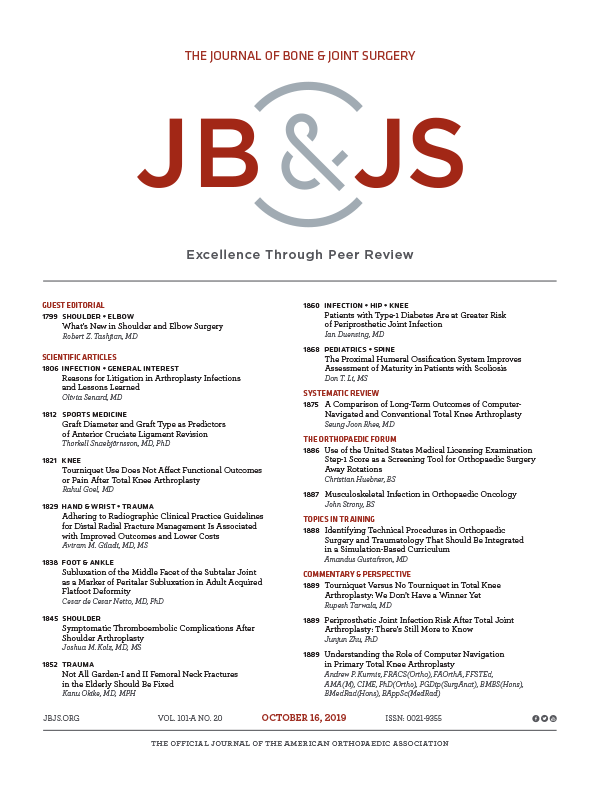
OE Journal. 2013;1(2):77 J Bone Joint Surg Am. 2010 Oct 20;92(14):2367-74. Epub 2010 Sep 10.51 physically active Finnish men with the acute rupture of the lateral ligament of the ankle were randomized to be treated with either the surgical repair and accelerated functional treatment or with traditional functional treatment using Aircast ankle brace. The long-term results of surgical treatment of acute lateral ligament rupture of the ankle corresponded well with functional treatment modalities alone; however, the surgical treatment had a lower re-rupture incidence, but was associated with higher rates of osteoarthritis of the ankle joint.
Was the allocation sequence adequately generated?
Was allocation adequately concealed?
Blinding Treatment Providers: Was knowledge of the allocated interventions adequately prevented?
Blinding Outcome Assessors: Was knowledge of the allocated interventions adequately prevented?
Blinding Patients: Was knowledge of the allocated interventions adequately prevented?
Was loss to follow-up (missing outcome data) infrequent?
Are reports of the study free of suggestion of selective outcome reporting?
Were outcomes objective, patient-important and assessed in a manner to limit bias (ie. duplicate assessors, Independent assessors)?
Was the sample size sufficiently large to assure a balance of prognosis and sufficiently large number of outcome events?
Was investigator expertise/experience with both treatment and control techniques likely the same (ie.were criteria for surgeon participation/expertise provided)?
Sim = 1
Incerto = 0,5
Não relevante = 0
Não = 0
A Avaliação dos Critérios de Relato avalia a transparência com que os autores relatam as caraterísticas metodológicas e do ensaio na publicação. A avaliação está dividida em cinco categorias que são apresentadas de seguida.
3/4
Asignación aleatoria
3/4
Criterios de resultado
4/4
Criterios de inclusión/exclusión
4/4
Descripción del tratamiento
1/4
Estadística
Detsky AS, Naylor CD, O'Rourke K, McGeer AJ, L'Abbé KA. J Clin Epidemiol. 1992;45:255-65
O Índice de Fragilidade é uma ferramenta que auxilia na interpretação de achados significativos, fornecendo uma medida de força para um resultado. O Índice de Fragilidade representa o número de eventos consecutivos que precisam de ser adicionados a um resultado dicotómico para que o resultado deixe de ser significativo. Um número pequeno representa um resultado mais fraco e um número grande representa um resultado mais forte.
Porque é que este estudo era necessário agora?
Lateral ligament ankle injuries are very common with over 300,000 cases reporting annually to emergency rooms in UK alone. The treatment of acute ruptures of the lateral ligaments is a controversial issue with insufficient evidence to compare surgical and non-surgical modalities. Previous studies have shown notable design flaws, such as short follow-ups, faulty randomizations, and heterogeneous study samples. This study evaluated the long term outcomes of the surgical vs non-surgical approaches.
Qual era a principal questão de investigação?
Does the surgery provide better long-term outcomes than a purely functional rehabilitation for the grade 3 lateral ankle ruptures?
Quais foram os resultados importantes?
- The prevalence of reinjury was 1/15 in the surgical group and 7/18 in the functional treatment group (risk difference: 32%; 95% confidence interval: 6% to 58%).
- The mean ankle score on Performance Test Protocol and Scoring Scale for the Evaluation of Ankle Injuries was not significantly different between the groups (mean difference: 8.3 points; 95% confidence interval:-0.03 to 16.6 points)
- Stress radiographs showed no differences between groups, with regard to the mean anterior drawer (1 mm in the surgical group and 0 mm in the functional group; mean difference: 0.7 mm; 95% confidence interval:1.4 to 2.7 mm) or mean tilt angle (0 degrees in both groups; mean difference: 0.1 degrees; 95% confidence interval: 3.2 degrees to 3.5 degrees)
- Grade-II osteoarthritis was observed on magnetic resonance images of 4/15 surgically treated patients and 0/18 for the functionally treated patients (risk difference: 27%; 95% confidence interval: 4% to 49%)
- 10/15 patients in the surgical group and 7/18 in functional group subjectively reported complete recovery (risk difference: 28%; 95% confidence interval: -5% to 61%). All patients in both groups recovered to preinjury activity level (walk and run normally)
- The level of physical activity, range of motion compared to contralateral ankle, and number of patients visiting a physician at the time of follow-up did not differ between the two groups.
- 3/15 surgical patients had loss of sensation in the lateral aspect of ankle and foot. No re-operations due to ankle instability, infections, or incidences of venous thrombosis were seen in either group.
De que é que me devo lembrar mais?
The recovery to preinjury levels of acute lateral grade III ligament rupture of the ankle was equivalent when using either surgical or nonoperative methods. Re-injury was significantly less in surgical group; however, there was significantly more OA present.
Como é que isto afectará o tratamento dos meus doentes?
This study questions whether to subject patients to surgical risks given the evidence of equal pre-injury recovery, and suggests that non-surgical treatments can be equally beneficial. However, larger sample sizes are needed to confirm these findings.

AVISO LEGAL
O conteúdo desta página destina-se apenas a fins informativos e não pretende substituir o aconselhamento, diagnóstico ou tratamento médico profissional. Se necessitar de tratamento médico, procure sempre o conselho do seu médico ou dirija-se ao serviço de urgência mais próximo. As opiniões, crenças e pontos de vista expressos pelos indivíduos no conteúdo encontrado nesta página não reflectem as opiniões, crenças e pontos de vista da OrthoEvidence.
0 de 4 artigos mensais GRATUITOS desbloqueados



