




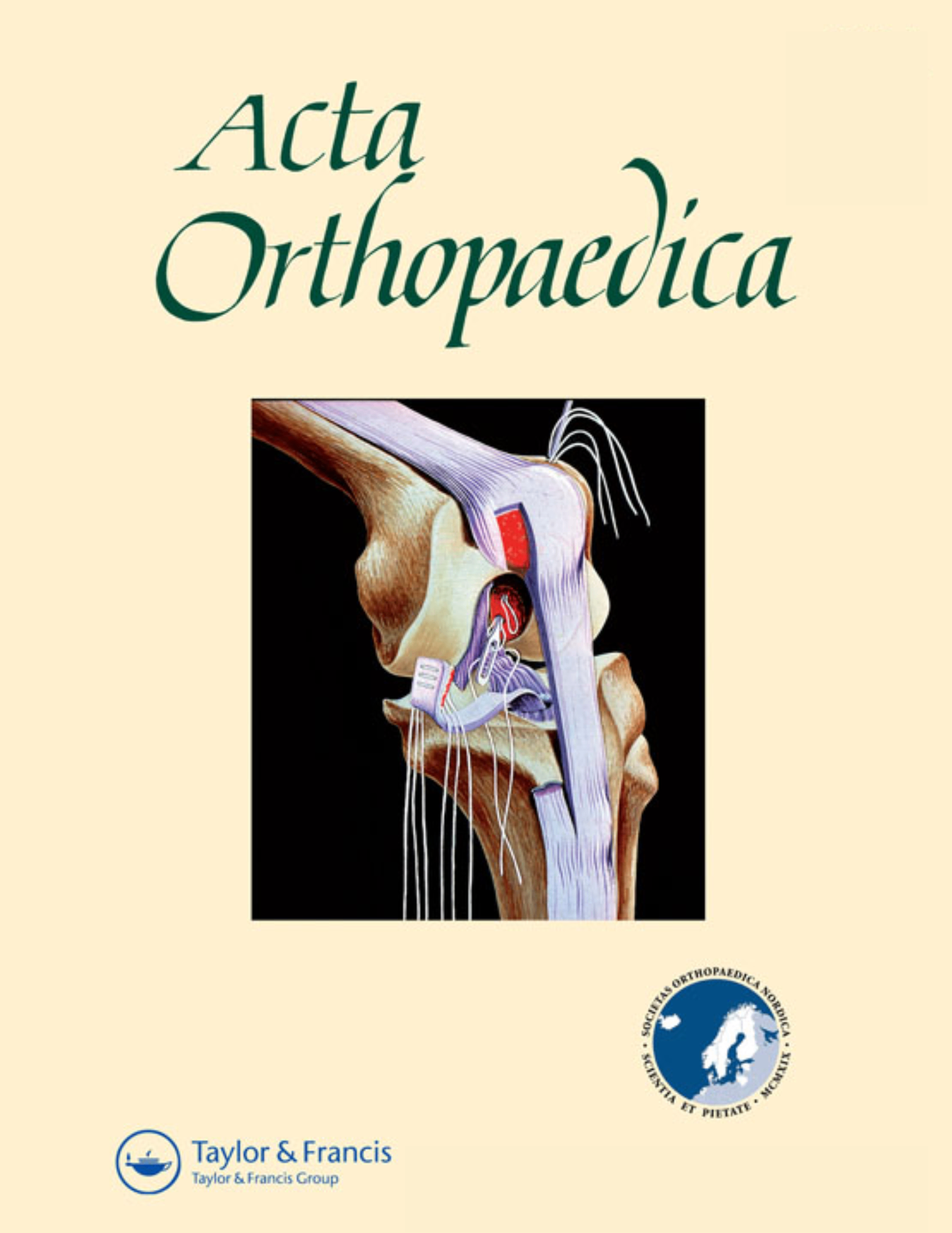






ARTHROPLASTY
The effect of adding tobramycin to Simplex P cement on femoral stem micromotion as measured by radiostereometric analysis: a 2-year randomized controlled trial
 This report has been verified
by one or more authors of the
original publication.
This report has been verified
by one or more authors of the
original publication.
OrthoEvidence Journal (OE Journal) - ACE Report
OE Journal. 2013;1(12):91 Acta Orthop. 2012 Apr;83(2):115-20. doi: 10.3109/17453674.2011.652885. Epub 2012 Jan 1728 patients scheduled for total hip arthroplasty were randomized to receive cementing of components with simplex P cement or simplex T cement (which is simplex P cement with 1g tobramycin added by the manufacturer), to determine the effect of the antibiotic on aseptic component loosening. Radiostereometric analysis (RSA) of migration and rotation of the femoral stem component and clinical outcomes of Harris Hip and Western Ontario and McMaster Universities Arthritis Index (WOMAC) scores were examined over 2 years. The results indicated that there were no significant differences between groups at any time and demonstrated that simplex T cement did not adversely affect component loosening and functional outcomes in total hip arthroplasty over 2 years.
Was the allocation sequence adequately generated?
Was allocation adequately concealed?
Blinding Treatment Providers: Was knowledge of the allocated interventions adequately prevented?
Blinding Outcome Assessors: Was knowledge of the allocated interventions adequately prevented?
Blinding Patients: Was knowledge of the allocated interventions adequately prevented?
Was loss to follow-up (missing outcome data) infrequent?
Are reports of the study free of suggestion of selective outcome reporting?
Were outcomes objective, patient-important and assessed in a manner to limit bias (ie. duplicate assessors, Independent assessors)?
Was the sample size sufficiently large to assure a balance of prognosis and sufficiently large number of outcome events?
Was investigator expertise/experience with both treatment and control techniques likely the same (ie.were criteria for surgeon participation/expertise provided)?
نعم = 1
غير مؤكد = 0.5
غير ذي صلة = 0
لا = 0
يقيّم تقييم معايير الإبلاغ الشفافية التي يبلغ بها المؤلفون عن الخصائص المنهجية والتجريبية للتجربة في المنشور. ينقسم التقييم إلى خمس فئات معروضة أدناه.
4/4
Randomização
4/4
Medidas de resultado
3/4
Inclusão/Exclusão
3/4
Descrição do tratamento
3/4
Estatística
Detsky AS, Naylor CD, O'Rourke K, McGeer AJ, L'Abbé KA. J Clin Epidemiol. 1992;45:255-65
مؤشر الهشاشة هو أداة تساعد في تفسير النتائج المهمة، وتوفر مقياسًا لقوة النتيجة. ويمثل مؤشر الهشاشة عدد الأحداث المتتالية التي يجب إضافتها إلى نتيجة ثنائية التفرع لجعل النتيجة غير مهمة. يمثل الرقم الصغير نتيجة أضعف ويمثل الرقم الكبير نتيجة أقوى.
لماذا كانت هناك حاجة لهذه الدراسة الآن؟
Since the introduction of antibiotic-laden bone cement, laboratory testing has shown that a 1 gram to 20 gram ratio of antibiotic to bone cement powder has a negligible effect on the mechanical strength and fixation properties of bone cement. However, the appropriateness of the laboratory testing has been questioned, since regulatory standards require testing after 24 hours, which does not necessarily translate into long-term clinical success. Furthermore, no study has directly examined antibiotic additives to bone cement with the risk of aseptic loosening of components, indicating the need for this trial.
ما هو سؤال البحث الرئيسي؟
Does Simplex T bone cement increase the risk of aseptic component loosening when measured after 2 years?
ما هي النتائج المهمة؟
- Mean subsidence after 2 years did not significantly differ between groups, with translation of 0.71mm (SD 0.30) in the control group (Simplex P) and 0.77mm (SD 0.36) in tobramycin-laden group (Simplex T) (Difference 0.06, 95%CI -0.21 to 0.34, p=0.6). Component translation did not significantly differ between groups at the 6 month (p=0.9) or 1 year (p=0.7) follow-up periods, either.
- The two groups did not significantly differ in mean retroversion of component after 2 years: 0.60 degrees (SD 0.72) for Simplex P group versus 0.84 degrees (0.93) for Simplex T group (Difference -0.24, 95%CI -0.94 to 0.47, p=0.5). Progression of retroversion at 6 months (p=0.6) and 1 year (p=0.6) follow-up were not significantly different between groups.
- Differences were not significant between groups in functional outcomes of Harris Hip Scores and WOMAC Scores at any point in the study. (all p-values>0.2).
- Cumulative migrations in the second year indicated substantial distal and moderate posterior migration of the stem, which was similar in both groups.
ما الذي يجب أن أتذكره أكثر؟
The addition of tobramycin to Simplex P bone cement had no effect on the subsidence and retroversion of the femoral stem, as well Harris hip and WOMAC functional scores, when compared to bone cement without antibiotic after 2 years.
كيف سيؤثر ذلك على رعاية مرضاي؟
The results of this trial indicated that antibiotic-laden bone cement is a safe method of cementing in total hip arthroplasty as it did not affect the subsidence and retroversion of the femoral stem component after 2 years. However, further studies with longer follow-up and larger sample sizes are necessary to assess the long-term results.

تنويه
هذا المحتوى الموجود في هذه الصفحة هو لأغراض إعلامية فقط وليس الغرض منه أن يكون بديلاً عن المشورة الطبية المتخصصة أو التشخيص أو العلاج. إذا كنت بحاجة إلى علاج طبي، اطلب دائمًا مشورة طبيبك أو اذهب إلى أقرب قسم طوارئ إليك. الآراء والمعتقدات ووجهات النظر التي يعبر عنها الأفراد في المحتوى الموجود في هذه الصفحة لا تعكس آراء ومعتقدات ووجهات نظر أورثوإيفيدنس.
0 من 4 مقالات مجانية شهرية غير مقفلة



