










ARTHROPLASTY
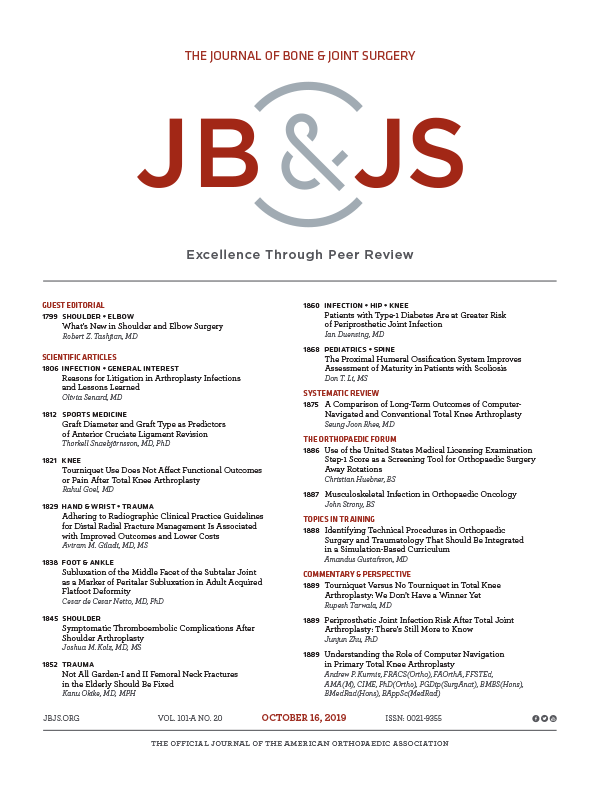
Comparison of Intravenous and Periarticular Administration of Corticosteroids in Total Knee Arthroplasty: A Prospective, Randomized Controlled Study
 Este relatório foi verificado
por um ou mais autores da publicação
publicação original.
Este relatório foi verificado
por um ou mais autores da publicação
publicação original.
 Este estudo foi identificado como tendo um impacto potencialmente elevado.
A métrica de Alto Impacto da OE, baseada em IA, estima a influência que um artigo poderá ter, integrando sinais da revista em que é publicado e do conteúdo científico do próprio artigo.
Desenvolvido com recurso ao mais avançado processamento de linguagem natural, o modelo High Impact da OE prevê com maior precisão o desempenho futuro de um estudo em termos de citações do que o fator de impacto da revista por si só.
Isto permite o reconhecimento precoce de investigação clinicamente significativa e ajuda os leitores a concentrarem-se nos artigos com maior probabilidade de moldar a prática futura.
Este estudo foi identificado como tendo um impacto potencialmente elevado.
A métrica de Alto Impacto da OE, baseada em IA, estima a influência que um artigo poderá ter, integrando sinais da revista em que é publicado e do conteúdo científico do próprio artigo.
Desenvolvido com recurso ao mais avançado processamento de linguagem natural, o modelo High Impact da OE prevê com maior precisão o desempenho futuro de um estudo em termos de citações do que o fator de impacto da revista por si só.
Isto permite o reconhecimento precoce de investigação clinicamente significativa e ajuda os leitores a concentrarem-se nos artigos com maior probabilidade de moldar a prática futura.
OrthoEvidence Journal (OE Journal) - ACE Report
OE Journal. 2021;9(6):5 J Bone Joint Surg Am. 2021 Feb 17;103(4): 319-325Resumo do estudo
One hundred patients with knee osteoarthritis (OA) scheduled for a unilateral total knee arthroplasty (TKA) were randomized to receive an intra-articular injection of dexamethasone (n=50) or peri-articular injection of triamcinolone acetonide (n=50). Outcomes of interest included the following: pain which was evaluated using the Numeric Rating Scale (NRS) at rest and during walking, nausea measured on NRS, incidence of vomiting, mean number of uses of rescue analgesia, number of patients with a fever, and mean number of uses of metoclopramide. Furthermore, inflammatory and serum markers were measured including levels of interleukin-6 (IL-6), C-reactive protein (CRP), and prothrombin fragment 1.2 (PF1.2), fasting blood glucose, and D-dimer. Pain at rest was measured at 4, 8, 16, 24, 48, and 72 hours and 1 week follow-up whereas pain during walking was measured at 24, 48, and 72 hours and 1 week follow-up. The number of uses of metoclopramide and rescue analgesia, and the incidence of vomiting were measured at 24-hours post-surgery. Nausea severity on a NRS was measured at 8, 24, and 48 hours post-surgery. Levels of IL-6 and CRP were measured at 24 and 48 hours, and CRP was measured at 1 week follow-up. Lastly, PF1.2 was only evaluated at 4 hours whereas D-dimer was measured at 24 and 48 hours and 1 week post-surgery. Results revealed that mean NRS pain during rest and pain during walking at 24 hours were statistically significantly reduced in the peri-articular injection group compared to the intravenous injection group(p<0.01 for both). Also, PF1.2 was also statistically significantly higher in the peri-articular injection group vs. the intravenous injection group at 4 hours post-surgery (p=0.006). CRP levels were statistically significantly lower in the intravenous injection group at 24 and 48 hours post-surgery, but statistically significantly higher at 1 week follow-up when compared to the peri-articular injection group (p<0.05 for all). All other outcomes at all other timepoints were not statistically significantly different between the 2 groups (p>0.05 for all). Two cases of deep vein thrombosis were observed in each arm, and no incidence of infection or delayed wound healing were observed in either group.
Desbloqueie o relatório completo da ACE
Tem acesso a 4 mais artigos GRATUITOS este mês.
Clique abaixo para desbloquear e ver este ACE Reports
Desbloqueie agora
Avaliações críticas dos mais recentes ensaios clínicos aleatórios de alto impacto e revisões sistemáticas em ortopedia
Acesso ao conteúdo do podcast OrthoEvidence, incluindo colaborações com o Journal of Bone and Joint Surgery, entrevistas com cirurgiões reconhecidos internacionalmente e discussões em mesa redonda sobre notícias e tópicos ortopédicos
Subscrição do The Pulse, um boletim informativo duas vezes por semana baseado em evidências, concebido para o ajudar a tomar melhores decisões clínicas
Acesso exclusivo a artigos de conteúdo original, incluindo revisões sistemáticas internas e artigos sobre métodos de investigação em saúde e tópicos ortopédicos importantes
Ou actualize hoje e obtenha acesso a todo o conteúdo da OrthoEvidence por apenas $1,99 por semana.
Já tem uma conta? Inicie sessão
Está afiliado a uma das nossas associações parceiras?
Clique aqui para obter acesso gratuito como parte dos benefícios de membro da sua associação!


Subscreva a "O Pulso"
Ortopedia baseada em evidências diretamente para a sua caixa de correio. SUBSCREVA-SE
0 de 4 artigos mensais GRATUITOS desbloqueados



