




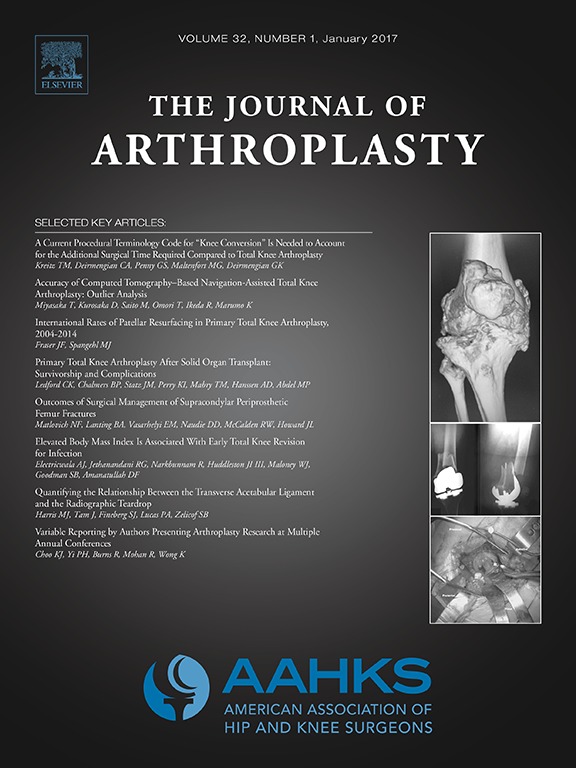






ARTHROPLASTY
The James A. Rand Young Investigator's Award: What Is the Safest and Most Effective Dose of Intravenous Dexamethasone in Total Knee Arthroplasty? A Multicenter Randomized Controlled Trial.
 Diese Studie wurde als potentiell hochwirksam eingestuft.
Die KI-gesteuerte High-Impact-Metrik von OE schätzt den Einfluss ein, den eine Arbeit wahrscheinlich haben wird, indem sie Signale sowohl der Zeitschrift, in der sie veröffentlicht wurde, als auch des wissenschaftlichen Inhalts des Artikels selbst integriert.
Das mit Hilfe modernster natürlicher Sprachverarbeitung entwickelte OE High Impact-Modell sagt die zukünftige Zitationsleistung einer Studie genauer voraus als der Impact-Faktor einer Zeitschrift allein.
Dies ermöglicht eine frühere Erkennung von klinisch bedeutsamer Forschung und hilft den Lesern, sich auf Artikel zu konzentrieren, die die zukünftige Praxis am ehesten beeinflussen werden.
Diese Studie wurde als potentiell hochwirksam eingestuft.
Die KI-gesteuerte High-Impact-Metrik von OE schätzt den Einfluss ein, den eine Arbeit wahrscheinlich haben wird, indem sie Signale sowohl der Zeitschrift, in der sie veröffentlicht wurde, als auch des wissenschaftlichen Inhalts des Artikels selbst integriert.
Das mit Hilfe modernster natürlicher Sprachverarbeitung entwickelte OE High Impact-Modell sagt die zukünftige Zitationsleistung einer Studie genauer voraus als der Impact-Faktor einer Zeitschrift allein.
Dies ermöglicht eine frühere Erkennung von klinisch bedeutsamer Forschung und hilft den Lesern, sich auf Artikel zu konzentrieren, die die zukünftige Praxis am ehesten beeinflussen werden.
OrthoEvidence Journal (OE Journal) - ACE Report
OE Journal. 2025;13(22):6 J Arthroplasty . 2025 Sep;40(9S1):S6-S12.Zusammenfassung der Studie
Four hundred and thirty eight patients undergoing inpatient primary TKA at 11 centers were randomized to receive 4 mg (n = 146), 8 mg (n = 147), or 16 mg (n = 145) of intraoperative IV dexamethasone, all within an identical multimodal analgesia/anesthesia protocol including neuraxial anesthesia, adductor canal block, periarticular injection, and standardized oral analgesics. The primary outcome was cumulative opioid consumption in oral morphine milligram equivalents (MME) over the first 48 hours postoperatively. Secondary outcomes included daily opioid use to 7 days, pain at rest and with activity, nausea scores, vomiting episodes, sleep duration, postoperative day 1 (POD1) glucose, length of stay, and 90-day complications. Outcomes were assessed with a 7-day patient diary and chart review through 90 days. Overall, the results of the study revealed that 16 mg IV dexamethasone modestly reduced early opioid consumption (particularly vs 8 mg), improved pain at rest and reduced vomiting within 24 hours, but increased POD1 glucose in a dose-dependent fashion without increasing short-term complication rates. These findings suggest that 16 mg may be the most efficacious dose for early postoperative comfort in otherwise well-controlled patients, while lower doses may be preferable in patients at higher risk from hyperglycemia.
Vollständigen ACE-Bericht freischalten
Sie haben Zugang zu 4 weiteren KOSTENLOSEN Artikeln in diesem Monat.
Klicken Sie unten, um diese ACE Reports freizuschalten und anzusehen
Jetzt freischalten
Kritische Beurteilungen der neuesten, hochwirksamen randomisierten kontrollierten Studien und systematischen Übersichten in der Orthopädie
Zugang zu OrthoEvidence-Podcast-Inhalten, einschließlich Kooperationen mit dem Journal of Bone and Joint Surgery, Interviews mit international anerkannten Chirurgen und Diskussionsrunden zu orthopädischen Neuigkeiten und Themen
Abonnement von The Pulse, einem zweimal wöchentlich erscheinenden evidenzbasierten Newsletter, der Ihnen helfen soll, bessere klinische Entscheidungen zu treffen
Exklusiver Zugang zu Originalartikeln, einschließlich eigener systematischer Übersichten, sowie zu Artikeln über Methoden der Gesundheitsforschung und aktuelle orthopädische Themen
Oder upgraden Sie noch heute und erhalten Sie Zugang zu allen OrthoEvidence-Inhalten für nur $1,99 pro Woche.
Sie haben bereits ein Konto? Einloggen
Gehören Sie zu einem unserer Partnerverbände?
Klicken Sie hier, um im Rahmen Ihrer Verbandsmitgliedschaft kostenlosen Zugang zu erhalten!


0 von 4 monatliche KOSTENLOSE Artikel freigeschaltet



