




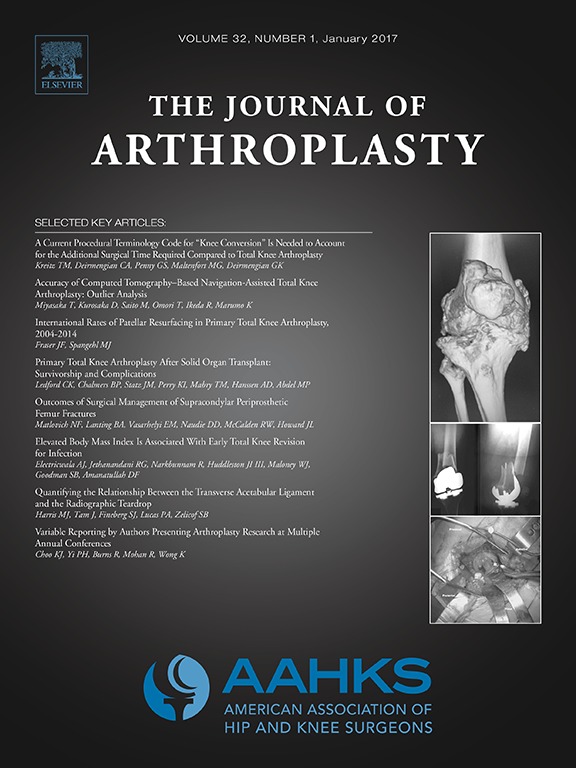






ARTHROPLASTY
The James A. Rand Young Investigator's Award: What Is the Safest and Most Effective Dose of Intravenous Dexamethasone in Total Knee Arthroplasty? A Multicenter Randomized Controlled Trial.
 This study has been identified as potentially high impact.
OE's AI-driven High Impact metric estimates the influence a paper is likely to have by integrating signals from both the journal in which it is published and the scientific content of the article itself.
Developed using state-of-the-art natural language processing, the OE High Impact model more accurately predicts a study's future citation performance than journal impact factor alone.
This enables earlier recognition of clinically meaningful research and helps readers focus on articles most likely to shape future practice.
This study has been identified as potentially high impact.
OE's AI-driven High Impact metric estimates the influence a paper is likely to have by integrating signals from both the journal in which it is published and the scientific content of the article itself.
Developed using state-of-the-art natural language processing, the OE High Impact model more accurately predicts a study's future citation performance than journal impact factor alone.
This enables earlier recognition of clinically meaningful research and helps readers focus on articles most likely to shape future practice.
OrthoEvidence Journal (OE Journal) - ACE Report
OE Journal. 2025;13(22):6 J Arthroplasty . 2025 Sep;40(9S1):S6-S12.Study Summary
Four hundred and thirty eight patients undergoing inpatient primary TKA at 11 centers were randomized to receive 4 mg (n = 146), 8 mg (n = 147), or 16 mg (n = 145) of intraoperative IV dexamethasone, all within an identical multimodal analgesia/anesthesia protocol including neuraxial anesthesia, adductor canal block, periarticular injection, and standardized oral analgesics. The primary outcome was cumulative opioid consumption in oral morphine milligram equivalents (MME) over the first 48 hours postoperatively. Secondary outcomes included daily opioid use to 7 days, pain at rest and with activity, nausea scores, vomiting episodes, sleep duration, postoperative day 1 (POD1) glucose, length of stay, and 90-day complications. Outcomes were assessed with a 7-day patient diary and chart review through 90 days. Overall, the results of the study revealed that 16 mg IV dexamethasone modestly reduced early opioid consumption (particularly vs 8 mg), improved pain at rest and reduced vomiting within 24 hours, but increased POD1 glucose in a dose-dependent fashion without increasing short-term complication rates. These findings suggest that 16 mg may be the most efficacious dose for early postoperative comfort in otherwise well-controlled patients, while lower doses may be preferable in patients at higher risk from hyperglycemia.
Unlock the Full ACE Report
You have access to 4 more FREE articles this month.
Click below to unlock and view this ACE Reports
Unlock Now
Critical appraisals of the latest, high-impact randomized controlled trials and systematic reviews in orthopaedics
Access to OrthoEvidence podcast content, including collaborations with the Journal of Bone and Joint Surgery, interviews with internationally recognized surgeons, and roundtable discussions on orthopaedic news and topics
Subscription to The Pulse, a twice-weekly evidence-based newsletter designed to help you make better clinical decisions
Exclusive access to original content articles, including in-house systematic reviews, and articles on health research methods and hot orthopaedic topics
Or upgrade today and gain access to all OrthoEvidencecontent for as little as $1.99 per week.
Already have an account? Log in
Are you affiliated with one of our partner associations?
Click here to gain complimentary access as part your association member benefits!


0 of 4 monthly FREE articles unlocked



