










HAND & WRIST
Methylprednisolone used for the carpal tunnel syndrome: a randomized, placebo-controlled trial.
 This report has been verified
by one or more authors of the
original publication.
This report has been verified
by one or more authors of the
original publication.
OrthoEvidence Journal (OE Journal) - ACE Report
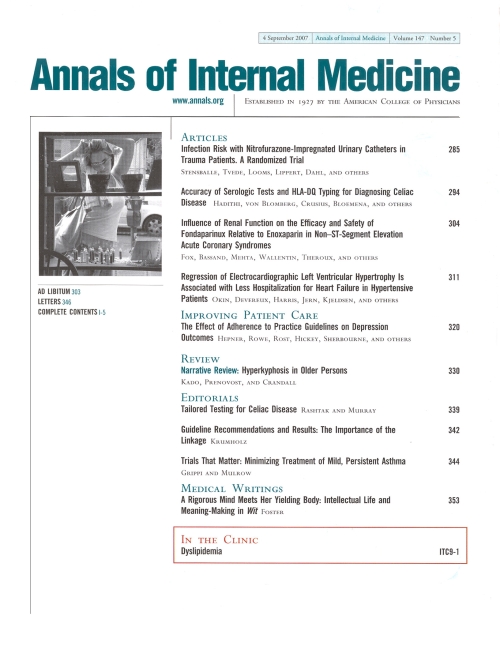
OE Journal. 2013;1(18):17 Ann Intern Med. 2013 Sep 3;159(5):309-17111 patients experiencing symptoms of classic or probable carpal tunnel syndrome (CTS) with failed wrist splinting treatment, were randomized to evaluate the long-term, dose-response efficacy of 80mg and 40mg of methylprednisolone injections on symptom severity and rate of surgery, over a 1 year period. The use of methylprednisolone of either dose demonstrated superior improvements in symptom severity at 10 weeks compared to placebo but no significant differences were found after 1 year. Rates of surgery were 73%, 81%, and 92% for 80mg, 40mg and placebo patients respectively.
Was the allocation sequence adequately generated?
Was allocation adequately concealed?
Blinding Treatment Providers: Was knowledge of the allocated interventions adequately prevented?
Blinding Outcome Assessors: Was knowledge of the allocated interventions adequately prevented?
Blinding Patients: Was knowledge of the allocated interventions adequately prevented?
Was loss to follow-up (missing outcome data) infrequent?
Are reports of the study free of suggestion of selective outcome reporting?
Were outcomes objective, patient-important and assessed in a manner to limit bias (ie. duplicate assessors, Independent assessors)?
Was the sample size sufficiently large to assure a balance of prognosis and sufficiently large number of outcome events?
Was investigator expertise/experience with both treatment and control techniques likely the same (ie.were criteria for surgeon participation/expertise provided)?
Sì = 1
Incerto = 0,5
Non rilevante = 0
No = 0
La valutazione dei criteri di segnalazione valuta la trasparenza con cui gli autori riportano le caratteristiche metodologiche e sperimentali dello studio all'interno della pubblicazione. La valutazione è suddivisa in cinque categorie che vengono presentate di seguito.
4/4
Asignación aleatoria
3/4
Criterios de resultado
4/4
Criterios de inclusión/exclusión
4/4
Descripción del tratamiento
4/4
Estadística
Detsky AS, Naylor CD, O'Rourke K, McGeer AJ, L'Abbé KA. J Clin Epidemiol. 1992;45:255-65
L'Indice di Fragilità è uno strumento che aiuta l'interpretazione dei risultati significativi, fornendo una misura della forza di un risultato. L'Indice di Fragilità rappresenta il numero di eventi consecutivi che devono essere aggiunti a un risultato dicotomico per rendere il risultato non più significativo. Un numero piccolo rappresenta un risultato più debole, mentre un numero grande rappresenta un risultato più forte.
Perché questo studio era necessario ora?
Carpal tunnel release surgery in the United States is performed yearly in almost 25 women and 13 men per 10,000 adults. The surgery itself results in good outcomes for affected patients but often presents with surgery-related pain, hand weakness, and further complications. Theoretically speaking, an equally effective, nonsurgical method could address these limitations, and recent evidence has supported the use of steroid injections in carpal tunnel surgery (CTS). No previous studies have reported on long-term benefits of steroid usage, or the dose-response relationship, and therefore this study was needed to determine the efficacy, symptom severity and risk of surgery associated with 1 year of first-time local injection of 2 different doses of methylprednisolone in idiopathic CTS patients.
Qual era la domanda di ricerca principale?
Is the use of 80mg or 40mg methylprednisolone in treatment for CTS an effective nonsurgical intervention for reducing syndrome symptoms, assessed over a period of 1 year?
Quali erano i risultati importanti?
- CTS symptom severity scores at 10 weeks improved more for methylprednisolone treated patients compared to placebo (p=0.003 for 80mg and p<0.001 for 40 mg). The mean change from baseline in the three groups at 10 weeks was -0.90 SD 1.0 for 80mg, -1.17 SD 0.95 for 40mg, and -0.30 SD 0.66 for placebo. No significant difference was found between the two methylprednisolone groups.
- At 10 weeks, patients who pursued surgery had exacerbated symptom severity scores compared with patients who did not pursue surgery (Mean Difference= 1.15; p> 0.05)
- At 1 year, 73%, 81% and 92% of patients had surgery in the 80mg, 40mg and the placebo groups, respectively. 80mg subgroup patients had a decreased likelihood of having surgery 1 year after injection compared with placebo (OR 0.24 p= 0.042); however, this was not significant for the 40mg subgroup compared with placebo (p> 0.05). Relative risk for surgery was 0.79 (p= 0.039) and 0.88 (p= 0.180) for the 80mg and 40mg methylprednisolone subgroups, respectively
- Time from injection to surgery was significantly longer for both intervention methylprednisolone subgroups (p= 0.003 for 80mg; p= 0.022 for 40mg) when compared against the placebo group. Methylprednisolone receiving patients exhibited a lower likelihood of undergoing surgery compared with the placebo patients (Hazard Ratio 0.46, p= 0.003 for 80mg; Hazard Ratio 0.57, p= 0.026 for 40mg). No difference was found for likelihood of surgery between methylprednisolone subgroups (Hazard Ratio: 0.81; p= 0.42)
- Quick DASH, SF-36 bodily pain, SF-6D, and treatment satisfaction were superior in both methylprednisolone subgroups compared with placebo (all p< 0.025), however long term analysis demonstrated no differences between groups for the listed measures at 24 weeks and 1 year (all p> 0.100).
- Rate of patient reported pain after injection was higher in methylprednisolone subgroups (24 patients) compared with the placebo group (6 patients; p< 0.001). No serious adverse events occurred and all pain was resolved within 2 weeks
- Patients with higher nerve conduction abnormality and baseline symptom severity benefited more from methylprednisolone. 80mg methylprednisolone subgroup patients demonstrated a greater improvement at 10 weeks for pinch strength (p= 0.44) and monofilament sensation (p= 0.010) compared with placebo. No other differences were observed (p> 0.100).
Che cosa devo ricordare di più?
The use of both doses of methylprednisolone (80mg and 40mg) in treatment for carpal tunnel syndrome (CTS) demonstrated significant improvements in CTS severity scores, when compared to the placebo at 10 weeks; however, this effect was no longer apparent at 24 weeks, and final 1 year follow-up. 1 year-rates of surgery were 73%, 81% and 92% in 80mg methylprednisolone, 40mg methylprednisolone, and placebo groups respectively. 80mg methylprednisolone administered patients were less likely to undergo surgery, and both methylprednisolone subgroups had greater time to surgery. Finally, subgroup analyses indicated that 80mg methylprednisolone resulted in superior outcomes for pinch strength and monofilament sensation when compared against placebo.
Come influenzerà l'assistenza ai miei pazienti?
The use of methylprednisolone injections for carpal tunnel syndrome (CTS) in affected patients is beneficial in the relief of symptom severity at 10 weeks and in reducing the rates of surgery after 1 year after treatment. However it should be noted that 3 of 4 patients still had surgery within 1 year. Future research should focus on conservative treatments that resolve carpal tunnel syndrome related symptoms and reduce the need for surgery.

DISCLAIMER
Il contenuto di questa pagina è solo a scopo informativo e non intende sostituire la consulenza, la diagnosi o il trattamento medico professionale. Se ha bisogno di cure mediche, si rivolga sempre al suo medico o al pronto soccorso più vicino. Le opinioni, le convinzioni e i punti di vista espressi dalle persone sui contenuti presenti in questa pagina non riflettono le opinioni, le convinzioni e i punti di vista di OrthoEvidence.
0 di 4 articoli mensili GRATUITI sbloccati



