










ARTHROPLASTY
Intravenous versus perineural dexmedetomidine as adjuvant in adductor canal block for total knee arthroplasty.
OrthoEvidence Journal (OE Journal) - ACE Report
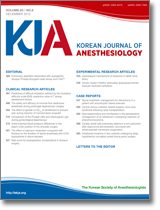
OE Journal. 2025;13(18):4 Korean J Anesthesiol . 2023 Aug;76(4):307-316.Study Summary
Fifty-six patients with ASA I–II status scheduled for unilateral primary TKA were randomized to receive intravenous dexmedetomidine 0.5 µg/kg plus ACB with levobupivacaine (n=28) or perineural dexmedetomidine 0.5 µg/kg added to levobupivacaine in the ACB with intravenous saline (n=28). The primary outcome was shivering incidence 1 hour after spinal anesthesia. Secondary outcomes included shivering severity, hemodynamics, pain scores at rest and with movement, duration of postoperative analgesia, rescue analgesic use, and sedation scores over 24 hours. Overall, the results revealed equal intraoperative shivering incidence (50%) but lower postoperative shivering and greater sedation with intravenous dosing, whereas perineural dosing produced faster sensory block onset, longer analgesia, lower pain scores, and reduced opioid use. In short, perineural dexmedetomidine as an ACB adjuvant improved postoperative analgesia but offered less postoperative shivering control than intravenous dexmedeto
Unlock the Full ACE Report
You have access to 4 more FREE articles this month.
Click below to unlock and view this ACE Reports
Unlock Now
Critical appraisals of the latest, high-impact randomized controlled trials and systematic reviews in orthopaedics
Access to OrthoEvidence podcast content, including collaborations with the Journal of Bone and Joint Surgery, interviews with internationally recognized surgeons, and roundtable discussions on orthopaedic news and topics
Subscription to The Pulse, a twice-weekly evidence-based newsletter designed to help you make better clinical decisions
Exclusive access to original content articles, including in-house systematic reviews, and articles on health research methods and hot orthopaedic topics
Or upgrade today and gain access to all OrthoEvidencecontent for as little as $1.99 per week.
Already have an account? Log in
Are you affiliated with one of our partner associations?
Click here to gain complimentary access as part your association member benefits!



0 of 4 monthly FREE articles unlocked



