










TRAUMA
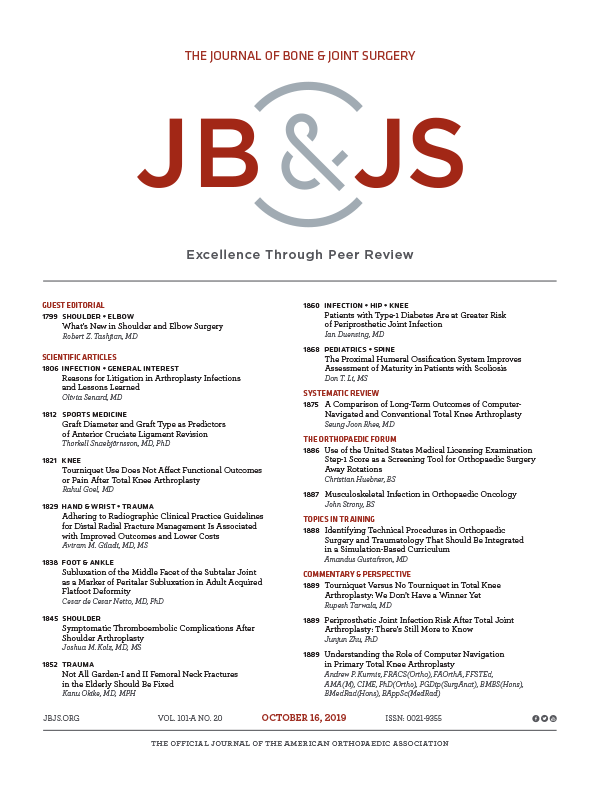
Three-Dimensional Compared with Two-Dimensional Preoperative Planning of Corrective Osteotomy for Extra-Articular Distal Radial Malunion: A Multicenter Randomized Controlled Trial
 This report has been verified
by one or more authors of the
original publication.
This report has been verified
by one or more authors of the
original publication.
 This study has been identified as potentially high impact.
OE's AI-driven High Impact metric estimates the influence a paper is likely to have by integrating signals from both the journal in which it is published and the scientific content of the article itself.
Developed using state-of-the-art natural language processing, the OE High Impact model more accurately predicts a study's future citation performance than journal impact factor alone.
This enables earlier recognition of clinically meaningful research and helps readers focus on articles most likely to shape future practice.
This study has been identified as potentially high impact.
OE's AI-driven High Impact metric estimates the influence a paper is likely to have by integrating signals from both the journal in which it is published and the scientific content of the article itself.
Developed using state-of-the-art natural language processing, the OE High Impact model more accurately predicts a study's future citation performance than journal impact factor alone.
This enables earlier recognition of clinically meaningful research and helps readers focus on articles most likely to shape future practice.
OrthoEvidence Journal (OE Journal) - ACE Report
OE Journal. 2018;6(19):40 J Bone Joint Surg Am. 2018 Jul 18;100(14):1191-120240 patients with a distal radius malunion were randomized to either 3-dimensional (3D) or 2-dimensional (2D) preoperative planning for corrective osteotomy. The primary outcome was the change in patient-reported disability on the Disabilities of the Arm, Shoulder, and Hand (DASH) questionnaire over 12-month follow-up; secondary measures included visual analog scales for pain and satisfaction, the Patient-Rated Wrist Evaluation, and radiographic assessment of deformity correction. No significant differences between groups were noted in the changes of the DASH, PRWE, VAS pain, or VAS satisfaction after 3, 6 or 12 months.
Unlock the Full ACE Report
You have access to 4 more FREE articles this month.
Click below to unlock and view this ACE Reports
Unlock Now
Critical appraisals of the latest, high-impact randomized controlled trials and systematic reviews in orthopaedics
Access to OrthoEvidence podcast content, including collaborations with the Journal of Bone and Joint Surgery, interviews with internationally recognized surgeons, and roundtable discussions on orthopaedic news and topics
Subscription to The Pulse, a twice-weekly evidence-based newsletter designed to help you make better clinical decisions
Exclusive access to original content articles, including in-house systematic reviews, and articles on health research methods and hot orthopaedic topics
Or upgrade today and gain access to all OrthoEvidencecontent for as little as $1.99 per week.
Already have an account? Log in
Are you affiliated with one of our partner associations?
Click here to gain complimentary access as part your association member benefits!



0 of 4 monthly FREE articles unlocked



