










TRAUMA
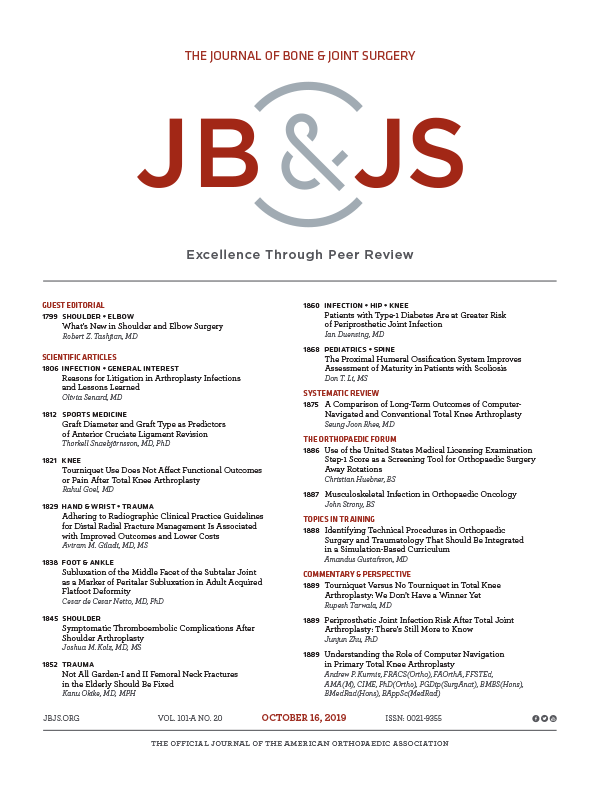
Hinged external fixation in the treatment of knee dislocations: a prospective randomized study
 This report has been verified
by one or more authors of the
original publication.
This report has been verified
by one or more authors of the
original publication.
OrthoEvidence Journal (OE Journal) - ACE Report
OE Journal. 2014;2(9):29 J Bone Joint Surg Am. 2014 Feb 5;96(3):184-91. doi: 10.2106/JBJS.L.01603.100 patients with a total of 103 knee dislocations were randomized to receive either a hinged knee brace or external fixation with a Compass Knee Hinge as part of a postoperative rehabilitation protocol. This study aimed to determine whether an external fixator would provide equivalent knee range of motion and improve failure rate in comparison to a hinged knee brace up to at least 1 year postoperatively. Results revealed significantly lower individual ligament reconstruction failure rates with the Compass Knee Hinge compared to hinged knee brace use. Lower knee reconstruction failure rates were also associated with the external fixator, but statistical significance was not achieved. Clinical outcome and knee range of motion statistics were similar between groups.
Was the allocation sequence adequately generated?
Was allocation adequately concealed?
Blinding Treatment Providers: Was knowledge of the allocated interventions adequately prevented?
Blinding Outcome Assessors: Was knowledge of the allocated interventions adequately prevented?
Blinding Patients: Was knowledge of the allocated interventions adequately prevented?
Was loss to follow-up (missing outcome data) infrequent?
Are reports of the study free of suggestion of selective outcome reporting?
Were outcomes objective, patient-important and assessed in a manner to limit bias (ie. duplicate assessors, Independent assessors)?
Was the sample size sufficiently large to assure a balance of prognosis and sufficiently large number of outcome events?
Was investigator expertise/experience with both treatment and control techniques likely the same (ie.were criteria for surgeon participation/expertise provided)?
نعم = 1
غير مؤكد = 0.5
غير ذي صلة = 0
لا = 0
يقيّم تقييم معايير الإبلاغ الشفافية التي يبلغ بها المؤلفون عن الخصائص المنهجية والتجريبية للتجربة في المنشور. ينقسم التقييم إلى خمس فئات معروضة أدناه.
4/4
Asignación aleatoria
2/4
Criterios de resultado
2/4
Criterios de inclusión/exclusión
2/4
Descripción del tratamiento
4/4
Estadística
Detsky AS, Naylor CD, O'Rourke K, McGeer AJ, L'Abbé KA. J Clin Epidemiol. 1992;45:255-65
مؤشر الهشاشة هو أداة تساعد في تفسير النتائج المهمة، وتوفر مقياسًا لقوة النتيجة. ويمثل مؤشر الهشاشة عدد الأحداث المتتالية التي يجب إضافتها إلى نتيجة ثنائية التفرع لجعل النتيجة غير مهمة. يمثل الرقم الصغير نتيجة أضعف ويمثل الرقم الكبير نتيجة أقوى.
لماذا كانت هناك حاجة لهذه الدراسة الآن؟
Knee dislocation can result in multiple-ligament injuries and are commonly caused from blunt trauma. Rehabilitation protocols have typically been focused on achieving and maintaining ligamentous stability following surgery. However, it has been suggested that such postoperative practices may compromise the long-term clinical outcome and increase the risk of arthrofibrosis, and that early aggressive protocols may be more beneficial. As such, the Compass Universal Hinge external fixator, initially developed for the elbow, was modified for the knee (Compass Knee Hinge) to accommodate these protocols, allowing early motion without increased stress. Thus, this study aimed to determine the efficacy of this device.
ما هو سؤال البحث الرئيسي؟
Does a Compass Knee Hinge external fixator provide comparable knee range of motion and result in fewer failures when compared to a control external hinge brace following ligament reconstruction after a minimum of 12 months?
ما هي النتائج المهمة؟
- 9 of 32 (28%) reconstructions failed with the control hinge knee brace versus 7 of 47 (15%) with the Compass Knee Hinge, a nonsignificant difference (p=0.15).
- A significantly larger percentage of individual ligament reconstruction failed with the control hinge knee brace (22/105 [21%]) compared to the Compass Knee Hinge (11/157 [7%]) (p<0.001).
- Mean Lysholm scores were similar between groups, with scores of 87.7 (range: 61-100) and 87.2 (69-100) in the control hinge knee brace and Compass Knee Hinge groups, respectively, up to 1 year postoperatively, and 90.1 and 89.9, respectively, up to 2 years postoperatively.
- IKDC subjective scores did not significantly differ between the control hinge knee brace and Compass Knee Hinge groups at 24 months; mean scores were 56.8 and 49.5, respectively. Acceptable IKDC objective scores (normal and nearly normal knees) were achieved in 75% and 81% of the groups, respectively.
- Mean VAS pain scores were similarly low between groups; 2.5 (range: 0-7) vs. 2.8 (0-8) for control hinge knee brace and Compass Knee Hinge, respectively.
- 82% of control hinge knee brace patients returned to work at full duty, 9% at light duty, and 9% did not return by final follow-up. In the Compass Knee Hinge group, these values were 73%, 9%, and 18%.
- Overall, knee range of motion was good in both groups at the final evaluation. Mean range of motion was from 1 to 132 deg in the control group, and 2 to 124 deg in the Compass Knee Hinge group.
ما الذي يجب أن أتذكره أكثر؟
Patients who received a Compass Knee Hinge had a significantly lower individual ligament reconstruction failure rate compared to those who received an control hinge knee brace. Lysholm scores, IKDC subjective and objective scores, VAS pain scores, knee range of motion, and percentage of patients returning to work were similar between groups.
كيف سيؤثر ذلك على رعاية مرضاي؟
The results indicated that progressive rehabilitation protocols can be achieved using a Compass Knee Hinge external fixator without compromising knee stability following knee reconstruction surgery. However, this device is expensive and takes time to apply, evoking a high learning curve and prolonging operation time. Future studies are warranted in larger populations to further investigate the efficacy of the Compass Knee Hinge.

تنويه
هذا المحتوى الموجود في هذه الصفحة هو لأغراض إعلامية فقط وليس الغرض منه أن يكون بديلاً عن المشورة الطبية المتخصصة أو التشخيص أو العلاج. إذا كنت بحاجة إلى علاج طبي، اطلب دائمًا مشورة طبيبك أو اذهب إلى أقرب قسم طوارئ إليك. الآراء والمعتقدات ووجهات النظر التي يعبر عنها الأفراد في المحتوى الموجود في هذه الصفحة لا تعكس آراء ومعتقدات ووجهات نظر أورثوإيفيدنس.
0 من 4 مقالات مجانية شهرية غير مقفلة



