











SPORTS MEDICINE
Single-bundle or double-bundle for anterior cruciate ligament reconstruction: A meta-analysis
 This report has been verified
by one or more authors of the
original publication.
This report has been verified
by one or more authors of the
original publication.
OrthoEvidence Journal (OE Journal) - ACE Report
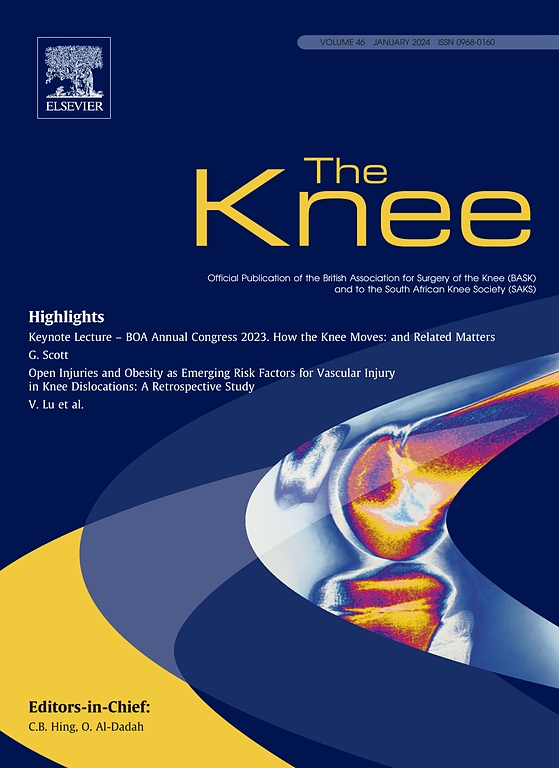
OE Journal. 2013;1(2):218 Knee. 2013 Jan 7. pii: S0968-0160(12)00236-0. doi: 10.1016/j.knee.2012.12.00419 randomized controlled trials (RCTs) involving 1686 patients were identified to examine the clinical outcomes of anterior cruciate ligament (ACL) reconstruction with double- and single-bundle techniques. Results revealed that the double-bundle technique led to better outcomes in rotational laxity (measured by the pivot-shift test, KT and IKDC grading). However, no significant difference was observed between the two techniques in terms of functional recovery.
Were the search methods used to find evidence (original research) on the primary question or questions stated?
Was the search for evidence reasonably comprehensive?
Were the criteria used for deciding which studies to include in the overview reported?
Was the bias in the selection of studies avoided?
Were the criteria used for assessing the validity of the included studies reported?
Was the validity of all of the studies referred to in the text assessed with use of appropriate criteria (either in selecting the studies for inclusion or in analyzing the studies that were cited)?
Were the methods used to combine the findings of the relevant studies (to reach a conclusion) reported?
Were the findings of the relevant studies combined appropriately relative to the primary question that the overview addresses?
Were the conclusions made by the author or authors supported by the data and or analysis reported in the overview?
How would you rate the scientific quality of this evidence?
Oui = 1
Incertain = 0,5
Non pertinent = 0
Non = 0
L'évaluation des critères de rapport permet d'évaluer la transparence avec laquelle les auteurs rapportent les caractéristiques méthodologiques et les caractéristiques de l'essai dans la publication. L'évaluation est divisée en cinq catégories qui sont présentées ci-dessous.
3/4
Introduction
4/4
Accessing Data
3/4
Analysing Data
3/4
Results
3/4
Discussion
Detsky AS, Naylor CD, O'Rourke K, McGeer AJ, L'Abbé KA. J Clin Epidemiol. 1992;45:255-65
L'indice de fragilité est un outil qui aide à l'interprétation des résultats significatifs, en fournissant une mesure de la force d'un résultat. L'indice de fragilité représente le nombre d'événements consécutifs qui doivent être ajoutés à un résultat dichotomique pour que le résultat ne soit plus significatif. Un petit nombre représente un résultat plus faible et un grand nombre un résultat plus fort.
Pourquoi cette étude était-elle nécessaire maintenant ?
While the single-bundle technique has been considered the gold standard for ACL reconstruction, a failure rate of 11-30% with persistent instability of the knee has been reported. The double-bundle technique was proposed to overcome these limitations, where the treatment was able to more closely restore normal kinematics to the knee. However, previous clinical results comparing these two techniques were riddled with controversial results. Therefore, this meta-analysis aimed to compare the outcome of single- and double-bundle reconstruction of the ACL.
Quelle était la principale question de recherche ?
Did a double-bundle ACL reconstruction technique lead to better clinical and functional outcomes than the single-bundle technique?
Quels sont les résultats importants ?
- According to 10 studies, a significant difference in Pivot shift grading between single and double-bundle techniques was observed (OR, 0.27, 95% CI 0.20, 0.36; P = 0.000, I-squared = 67.3%).
- 2 trials indicated significant differences in KT grading between the two reconstruction techniques (OR, 0.44, 95% CI 0.21, 0.95; P = 0.035, I-squared = 0.00%).
- 6 studies reported a significant difference in IKDC grading between the two methods (OR, 0.59, 95% CI 0.40, 0.87; P = 0.008, I-squared = 0.00%).
- No significant differences were observed in complications, IKDC scores, Lysholm Knee scores, and Tegner activity scores between the two treatments.
- While no significant difference was observed in KT arthrometer between the groups (from 9 studies), none of the co-variables (year P = 0.439, study type P = 0.764) could explain heterogeneity by meta-regression, and the heterogeneity may be due to different follow-up.
De quoi dois-je me souvenir en priorité ?
This study demonstrated that double-bundle ACL reconstruction led to better outcomes in rotational laxity (assessed through the pivot-shift test, KT and IKDC grading) compared to the single-bundle technique. However, no significant difference was observed in functional outcome measures such as IKDC scores, KT arthrometer, Lysholm knee, or Tegner activity scores.
Comment cela affectera-t-il les soins prodigués à mes patients ?
The double-bundle ACL reconstruction technique seems to be superior to the single-bundle method in terms of objective measures. However, the reliability of these findings is uncertain as the methodological quality of the included RCTs was difficult to assess (due to lack of randomization and concealment). Furthermore, it is unclear how more 'anatomic' single bundle reconstruction techniques fare against the double-bundle techniques. As clinical results seem equivalent based on available data, further results could be aimed at determining if the suggested improvement in mechanical stability affords improved clinical benefits in some population groups (i.e. high performance athletes).

AVIS DE NON-RESPONSABILITÉ
Le contenu de cette page est fourni à titre d'information uniquement et n'est pas destiné à remplacer un avis médical, un diagnostic ou un traitement professionnel. Si vous avez besoin d'un traitement médical, demandez toujours l'avis de votre médecin ou rendez-vous au service des urgences le plus proche. Les opinions, croyances et points de vue exprimés par les individus sur le contenu de cette page ne reflètent pas les opinions, croyances et points de vue d'OrthoEvidence.
0 de 4 articles mensuels GRATUITS débloqués



