










ARTHROPLASTY
Periprosthetic bone loss after insertion of an uncemented, customized femoral stem and an uncemented anatomical stem
OrthoEvidence Journal (OE Journal) - ACE Report
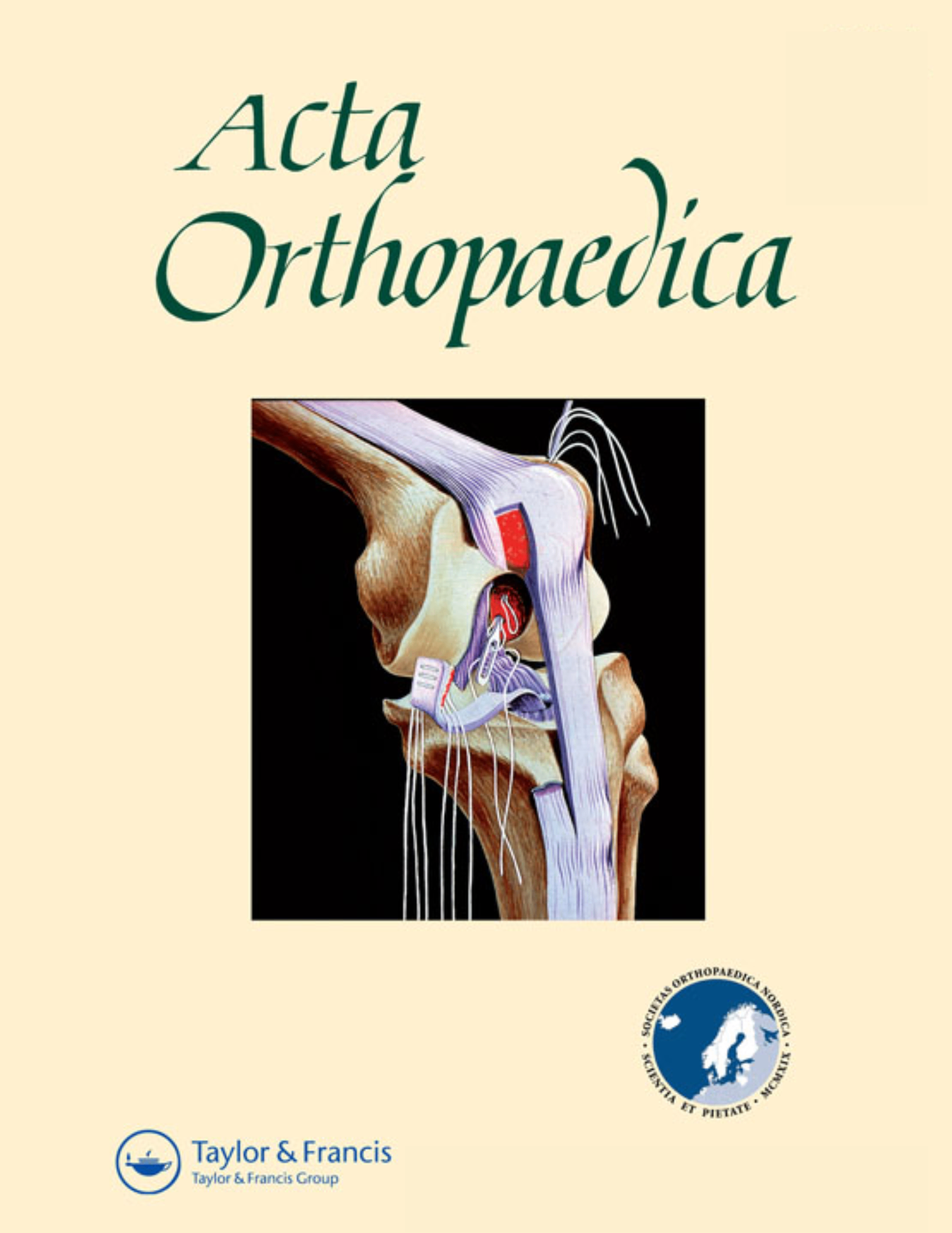
OE Journal. 2013;1(2):20 Acta Orthop. 2011 Aug;82(4):410-6. Epub 2011 Jun 1487 patients were randomized to undergo hip arthroplasty with an uncemented customized unique femoral stem or a uncemented ABG-I anatomical stem. The primary outcome examined was periprosthetic bone loss (change in bone mineral density), measured by Dual-energy X-ray absorptiometry (DXA) from baseline to the follow-up. The results indicated loss in bone mineral density for both customized femoral and uncemented anatomical stem at the 5-year (medium-term) follow-up.
Was the allocation sequence adequately generated?
Was allocation adequately concealed?
Blinding Treatment Providers: Was knowledge of the allocated interventions adequately prevented?
Blinding Outcome Assessors: Was knowledge of the allocated interventions adequately prevented?
Blinding Patients: Was knowledge of the allocated interventions adequately prevented?
Was loss to follow-up (missing outcome data) infrequent?
Are reports of the study free of suggestion of selective outcome reporting?
Were outcomes objective, patient-important and assessed in a manner to limit bias (ie. duplicate assessors, Independent assessors)?
Was the sample size sufficiently large to assure a balance of prognosis and sufficiently large number of outcome events?
Was investigator expertise/experience with both treatment and control techniques likely the same (ie.were criteria for surgeon participation/expertise provided)?
Oui = 1
Incertain = 0,5
Non pertinent = 0
Non = 0
L'évaluation des critères de rapport permet d'évaluer la transparence avec laquelle les auteurs rapportent les caractéristiques méthodologiques et les caractéristiques de l'essai dans la publication. L'évaluation est divisée en cinq catégories qui sont présentées ci-dessous.
4/4
Randomization
3/4
Outcome Measurements
4/4
Inclusion / Exclusion
4/4
Therapy Description
3/4
Statistics
Detsky AS, Naylor CD, O'Rourke K, McGeer AJ, L'Abbé KA. J Clin Epidemiol. 1992;45:255-65
L'indice de fragilité est un outil qui aide à l'interprétation des résultats significatifs, en fournissant une mesure de la force d'un résultat. L'indice de fragilité représente le nombre d'événements consécutifs qui doivent être ajoutés à un résultat dichotomique pour que le résultat ne soit plus significatif. Un petit nombre représente un résultat plus faible et un grand nombre un résultat plus fort.
Pourquoi cette étude était-elle nécessaire maintenant ?
Implantation of a prosthesis can change the load distribution of the host bone. Customized femoral stems are, therefore, specifically designed to provide optimal physiological load transfer and minimize stress shielding. This study examines the outcomes in periprosthetic bone loss using DXA in hip arthroplasties implementing an uncemented customized femoral stem and an uncemented anatomical stem.
Quelle était la principale question de recherche ?
What are the outcomes in periprosthetic bone loss (change in bone density),when undergoing hip arthroplasty with an uncemented customized unique femoral stem, compared to an uncemented anatomical ABG-I stem in patients with primary or secondary osteoarthritis at 5 years?
Quels sont les résultats importants ?
- The proximal Gruen zones showed the greatest degree of bone loss in both the anatomical ABG-I stem group and the customized Unique stem group.
- There was a statistically significant difference in bone mineral density (BMD) reduction at Gruen zone 4 between the two groups. The ABG-I group had at 1.6% reduction in BMD compared to a 9.7% reduction in the Unique group (p=0.003)
- The ABG-I group had at 15% reduction in BMD at zone 1, compared to a 14% reduction in the Unique group. At zone 7, the ABG-I group had at 28% reduction reduction in BMD compared to a 27% reduction in the Unique group.
- The Unique group showed significant differences in BMD in Gruen zones 1, 2, 3, 4, and 7 when compared to baseline (p<0.001). The ABG-I group showed significant differences in BMD in Gruen zones 1, 2, 6, and 7 when compared to baseline (p<0.001).
- No patients required hip revision surgery at the 5-year follow-up, but 5 patients reported complications. The ABG-I group had 2 patients with an early dislocation, 1 patient developed a deep venous thrombosis, and 1 patient had an episode of subluxation. 1 patient from the Unique group had an intraoperative injury of the common peroneal nerve.
De quoi dois-je me souvenir en priorité ?
Both the anatomical and customized stems had proximal bone loss at the 5-year follow-up - this was unavoidable due to stress-shielding.
Comment cela affectera-t-il les soins prodigués à mes patients ?
There is still uncertainty regarding the clinical consequences of proximal bone loss around uncemented stems in the medium- and long-term . Further research is needed to better define the effects of proximal bone loss following total hip arthroplasty.

AVIS DE NON-RESPONSABILITÉ
Le contenu de cette page est fourni à titre d'information uniquement et n'est pas destiné à remplacer un avis médical, un diagnostic ou un traitement professionnel. Si vous avez besoin d'un traitement médical, demandez toujours l'avis de votre médecin ou rendez-vous au service des urgences le plus proche. Les opinions, croyances et points de vue exprimés par les individus sur le contenu de cette page ne reflètent pas les opinions, croyances et points de vue d'OrthoEvidence.
0 de 4 articles mensuels GRATUITS débloqués



