










ARTHROPLASTY
Intra-articular local anaesthetic on the day after surgery improves pain and patient satisfaction after Unicompartmental Knee Replacement: a randomised controlled trial
OrthoEvidence Journal (OE Journal) - ACE Report
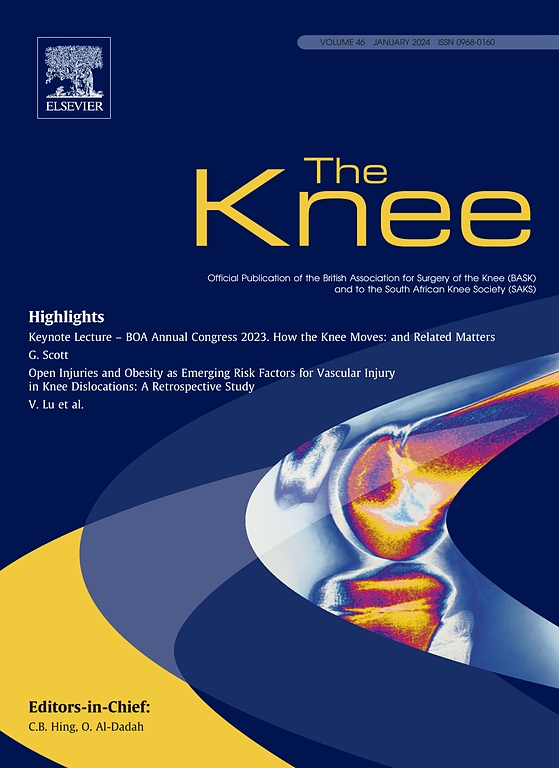
OE Journal. 2013;1(11):42 Knee. 2012 Aug;19(4):352-5. Epub 2011 Jun 1244 patients with end stage osteoarthritis, scheduled to undergo uni-compartmental knee replacement (UKR), were randomized to assess the efficacy of a 24 hour post-operative intra-articular local anaesthetic infusion. Patients either received a 20 ml bolus of 0.5% bupivacaine or a 20 ml bolus of saline. Results over the first 48 hours indicated the anaesthetic injection resulted in a significant decrease in pain and in a greater patient satisfaction than controls, between 24 and 48 hours postoperatively.
Was the allocation sequence adequately generated?
Was allocation adequately concealed?
Blinding Treatment Providers: Was knowledge of the allocated interventions adequately prevented?
Blinding Outcome Assessors: Was knowledge of the allocated interventions adequately prevented?
Blinding Patients: Was knowledge of the allocated interventions adequately prevented?
Was loss to follow-up (missing outcome data) infrequent?
Are reports of the study free of suggestion of selective outcome reporting?
Were outcomes objective, patient-important and assessed in a manner to limit bias (ie. duplicate assessors, Independent assessors)?
Was the sample size sufficiently large to assure a balance of prognosis and sufficiently large number of outcome events?
Was investigator expertise/experience with both treatment and control techniques likely the same (ie.were criteria for surgeon participation/expertise provided)?
Ja = 1
Ungewiss = 0.5
Nicht relevant = 0
Nein = 0
Die Bewertung der Berichtskriterien bewertet die Transparenz, mit der die Autoren die methodischen und studienspezifischen Merkmale der Studie in der Veröffentlichung angeben. Die Bewertung ist in fünf Kategorien unterteilt, die im Folgenden vorgestellt werden.
4/4
Randomization
4/4
Outcome Measurements
2/4
Inclusion / Exclusion
4/4
Therapy Description
2/4
Statistics
Detsky AS, Naylor CD, O'Rourke K, McGeer AJ, L'Abbé KA. J Clin Epidemiol. 1992;45:255-65
Der Fragilitätsindex ist ein Instrument, das bei der Interpretation signifikanter Ergebnisse hilft und ein Maß für die Stärke eines Ergebnisses liefert. Der Fragilitätsindex gibt die Anzahl der aufeinanderfolgenden Ereignisse an, die zu einem dichotomen Ergebnis hinzugefügt werden müssen, damit das Ergebnis nicht mehr signifikant ist. Eine kleine Zahl steht für ein schwächeres Ergebnis und eine große Zahl für ein stärkeres Ergebnis.
Warum wurde diese Studie jetzt benötigt?
Total knee and uni-compartmental knee replacement procedures are associated with considerable post-operative pain. The use of number of peri-operative analgesic regimes have been demonstrated to be effective in reducing the post-operative pain and decreasing the total time until hospital discharge. While these methods appear to be effective in reducing the immediate post-operative pain, recent findings have indicated that an appreciable number of patients suffer pain during the first postoperative day, as the nerve block and local analgesia wear off. This may lead to an increased time until mobilization and subsequently hospital discharge. Local infiltration analgesia early on the first post-operative day may address this increase in pain and improve patient satisfaction while decreasing the length of hospital stay.
Was war die wichtigste Forschungsfrage?
Does the use of intra-articular analgesia administer on the first post-operative day through a catherter inserted into the knee during the operation result in decreased pain and improved patient satisfaction compared to controls, measured over the first 48 postoperative hours?
Was waren die wichtigsten Ergebnisse?
- Over the first post-operative 24 hours, there were no differences in VAS pain scores between the two groups, as well as prior to the injection of the first 24 hours through the intra-articular catheter. (P>0.05)
- VAS pain scores prior to the 24 hours injection were 6.32 +/- 2.01 in group A and 5.15 +/- 2.31 in group C.
- Patients in group A had significantly lower VAS pain scores immediately following the injection after the first 24 hours, (1.8 +/- 1.40 vs 6.1 +/- 1.94 (p<0.001)) and 6 hours following the injection, (2.5 +/- 1.82 vs 5.7 +/- 1.92 (p<0.001))
- Both groups initially reported a high degree of postoperative satisfaction post infiltration. There was a significant difference between the two groups with group A indicating greater satisfaction (p<0.001).
- Requirement for rescue analgesia was similar between groups over the first 24 hours, following infiltration 75% of the control group required rescue analgesia compared to 22% of the anaesthetic group (p<0.001). The mean opiate requirement was also different with the controls requiring 12.1 +/- 9.39 mg and the anaesthetic group requiring 3.6 +/- 7.27 (p<0.01)
- There were no complications reported in any group
Was sollte ich mir besonders merken?
The use of an intra-articular injection of bupivacaine 24 hours following uni-compartmental knee replacement produces a significant reduction in postoperative pain during the 24 to 48 hour postoperative period and improves patient satisfaction in comparison controls receiving a saline injection.
Wie wird sich dies auf die Behandlung meiner Patienten auswirken?
The use of an intra-articular analgesic infiltration 24 hours postoperatively can significantly reduce patient pain and improve satisfaction. For this reason surgeons should consider it as a possible addition to current analgesic regimes. Additional research should be undertaken to determine if this 24 hour post-operative injection produces a reduction in hospitalization time.

HAFTUNGSAUSSCHLUSS
Der Inhalt dieser Seite dient nur zu Informationszwecken und ist nicht als Ersatz für professionelle medizinische Beratung, Diagnose oder Behandlung gedacht. Wenn Sie eine medizinische Behandlung benötigen, wenden Sie sich immer an Ihren Arzt oder suchen Sie die nächstgelegene Notaufnahme auf. Die Meinungen, Überzeugungen und Standpunkte, die von den Personen auf dieser Seite geäußert werden, spiegeln nicht die Meinungen, Überzeugungen und Standpunkte von OrthoEvidence wider.
0 von 4 monatliche KOSTENLOSE Artikel freigeschaltet



