










OSTEOARTHRITIS
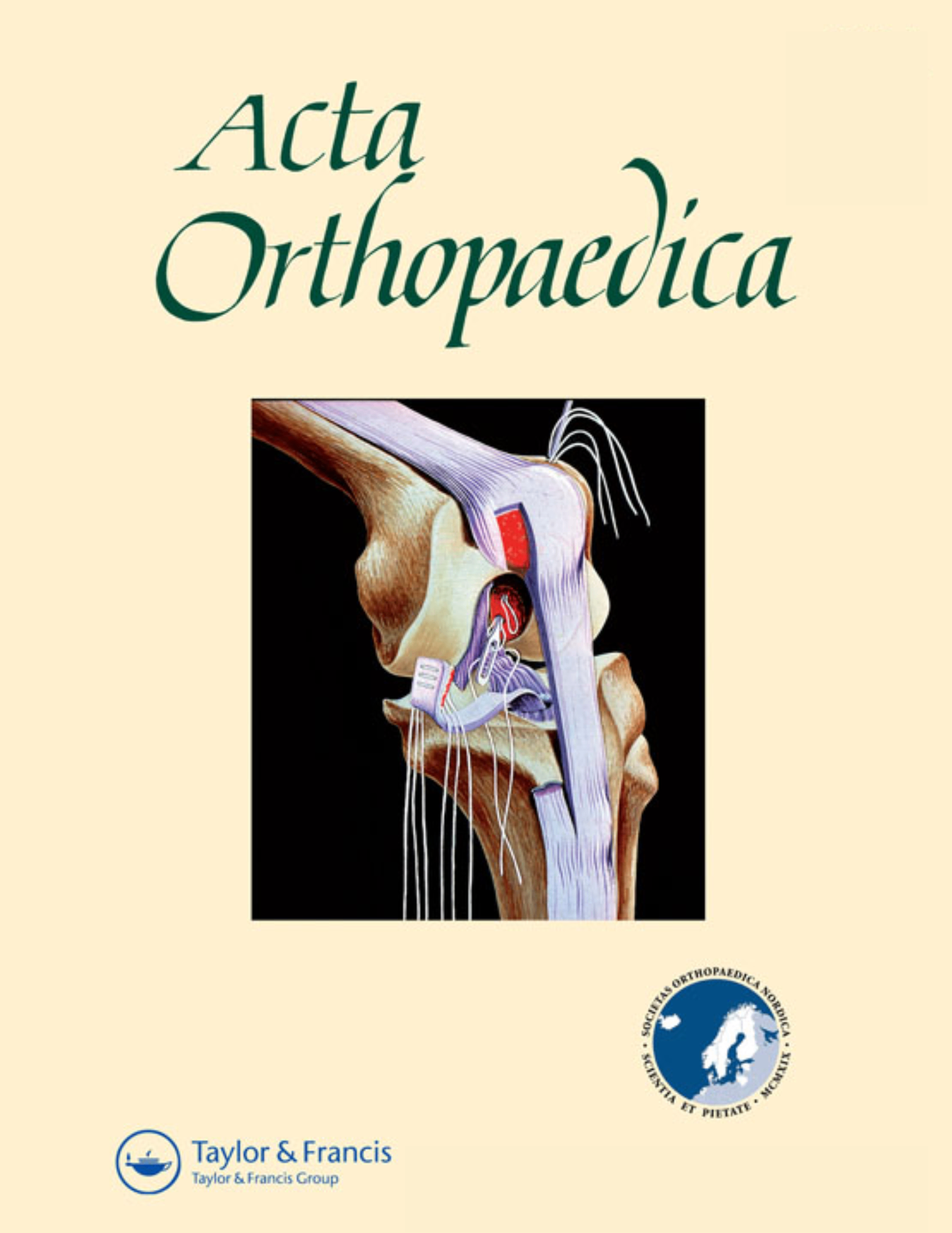
Superior fixation of pegged trabecular metal over screw-fixed pegged porous titanium fiber mesh: A randomized clinical RSA study on cementless tibial components
 This report has been verified
by one or more authors of the
original publication.
This report has been verified
by one or more authors of the
original publication.
OrthoEvidence Journal (OE Journal) - ACE Report
OE Journal. 2013;1(2):108 Acta Orthop. 2011 Apr;82(2):177-86.50 patients were randomized to receive either high-porosity trabecular metal (TM) tibial components or low-porosity titanium pegged porous fiber-metal (Ti) components in the treatment of primary osteoarthritis of the knee. This study was performed to compare the stability of these cementless implants. The results indicated that TM tibial components migrated less than the Ti components at 1 and 2 year post-surgery follow-ups.
Was the allocation sequence adequately generated?
Was allocation adequately concealed?
Blinding Treatment Providers: Was knowledge of the allocated interventions adequately prevented?
Blinding Outcome Assessors: Was knowledge of the allocated interventions adequately prevented?
Blinding Patients: Was knowledge of the allocated interventions adequately prevented?
Was loss to follow-up (missing outcome data) infrequent?
Are reports of the study free of suggestion of selective outcome reporting?
Were outcomes objective, patient-important and assessed in a manner to limit bias (ie. duplicate assessors, Independent assessors)?
Was the sample size sufficiently large to assure a balance of prognosis and sufficiently large number of outcome events?
Was investigator expertise/experience with both treatment and control techniques likely the same (ie.were criteria for surgeon participation/expertise provided)?
Sí = 1
Incierto = 0,5
No relevante = 0
No = 0
La evaluación de los criterios de información evalúa la transparencia con la que los autores informan de las características metodológicas y del ensayo dentro de la publicación. La evaluación se divide en cinco categorías que se presentan a continuación.
3/4
Randomization
3/4
Outcome Measurements
4/4
Inclusion / Exclusion
4/4
Therapy Description
4/4
Statistics
Detsky AS, Naylor CD, O'Rourke K, McGeer AJ, L'Abbé KA. J Clin Epidemiol. 1992;45:255-65
El Índice de Fragilidad es una herramienta que ayuda en la interpretación de hallazgos significativos, proporcionando una medida de fuerza para un resultado. El Índice de Fragilidad representa el número de eventos consecutivos que es necesario añadir a un resultado dicotómico para que el hallazgo deje de ser significativo. Un número pequeño representa un hallazgo más débil y un número grande un hallazgo más fuerte.
¿Por qué se necesitaba ahora este estudio?
There is currently insufficient evidence regarding the efficacy of high-porosity double-pegged trabecular metal versus low-porosity titanium pegged fiber-metal as a cementless tibial component for patients suffering from primary knee osteoarthritis.
¿Cuál era la pregunta principal de la investigación?
Does a high-porosity double-pegged trabecular metal component tibial lead to improved fixation as compared to a low-porosity titanium fiber-metal tibial component in patients undergoing intervention for primary knee osteoarthritis, when measured two years post-operatively?
¿Cuáles fueron los hallazgos importantes?
- Migration of the trabecular (TM) component was significantly less than the low-porosity titanium component. This result was significant at both the one year (p = .01) and two year follow-up (p = .004).
- AKSS reports of both groups indicated reductions in pain at 2 year follow-up compared to preoperative scores, with 14/22 in the TI group and 17/23 in the TM group, reporting no pain.
¿Qué es lo que más debo recordar?
The trabecular metal component was superior to the low-porosity titanium component in terms of total migration, measured two years postoperatively.
¿Cómo afectará esto al cuidado de mis pacientes?
This study provides support for the use of porous tantalum as an alternative to traditional implants. However, the small sample size of the study and the unknown results of longer term follow up should be considered.

DESCARGO DE RESPONSABILIDAD
El contenido de esta página tiene únicamente fines informativos y no pretende sustituir el consejo, diagnóstico o tratamiento médico profesional. Si necesita tratamiento médico, busque siempre el consejo de su médico o acuda al servicio de urgencias más cercano. Las opiniones, creencias y puntos de vista expresados por las personas sobre el contenido que se encuentra en esta página no reflejan las opiniones, creencias y puntos de vista de OrthoEvidence.
0 de 4 artículos mensuales GRATIS desbloqueados



