










SHOULDER & ELBOW
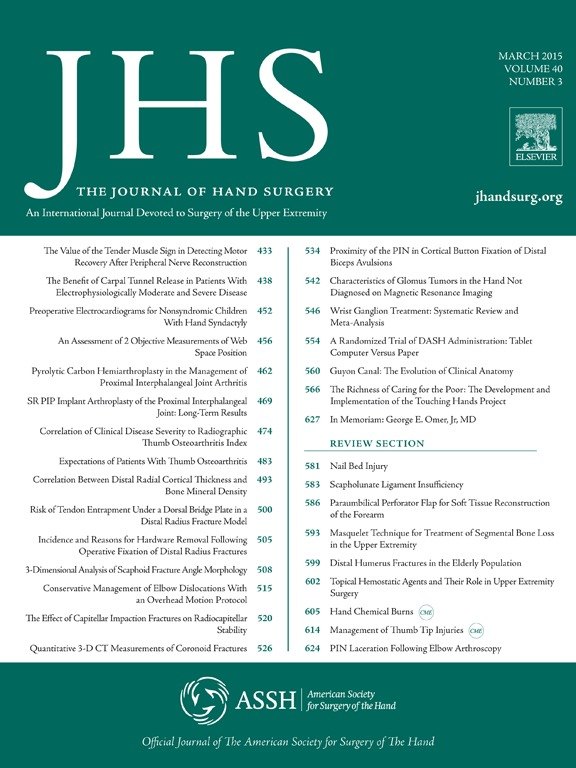
Supination Peak Tourque After Inlay Versus Onlay Distal Biceps Reinsertion: A Randomized Controlled Trial.
OrthoEvidence Journal (OE Journal) - ACE Report
OE Journal. 2025;13(16):39 J Hand Surg Am . 2025 Jun;50(6):670-676.Study Summary
Forty male patients with complete distal biceps tendon ruptures were randomized to undergo repair with either onlay fixation using suture anchors (n=20) or inlay fixation using a bicortical button (n=20). The primary outcome was supination peak torque recovery, assessed preoperatively and at ≥6 months postoperatively at 45°, 90°, and 120° of elbow flexion. Secondary outcomes included comparison with the contralateral arm, strength changes across elbow positions, and complication rates. At follow-up, 34 patients were analyzed (17 in each group). Both groups demonstrated >100% recovery of supination strength relative to preoperative injured-limb values, with no significant differences between fixation techniques. Overall, the results revealed that both inlay and onlay fixation yielded comparable and excellent recovery of supination torque. These findings suggest that either technique can be effectively used depending on surgeon preference and contextual factors.
Unlock the Full ACE Report
You have access to 4 more FREE articles this month.
Click below to unlock and view this ACE Reports
Unlock Now
Critical appraisals of the latest, high-impact randomized controlled trials and systematic reviews in orthopaedics
Access to OrthoEvidence podcast content, including collaborations with the Journal of Bone and Joint Surgery, interviews with internationally recognized surgeons, and roundtable discussions on orthopaedic news and topics
Subscription to The Pulse, a twice-weekly evidence-based newsletter designed to help you make better clinical decisions
Exclusive access to original content articles, including in-house systematic reviews, and articles on health research methods and hot orthopaedic topics
Or upgrade today and gain access to all OrthoEvidencecontent for as little as $1.99 per week.
Already have an account? Log in
Are you affiliated with one of our partner associations?
Click here to gain complimentary access as part your association member benefits!


0 of 4 monthly FREE articles unlocked



