










ARTHROPLASTY
Similar range of motion and function after resurfacing large-head or standard total hip arthroplasty
OrthoEvidence Journal (OE Journal) - ACE Report
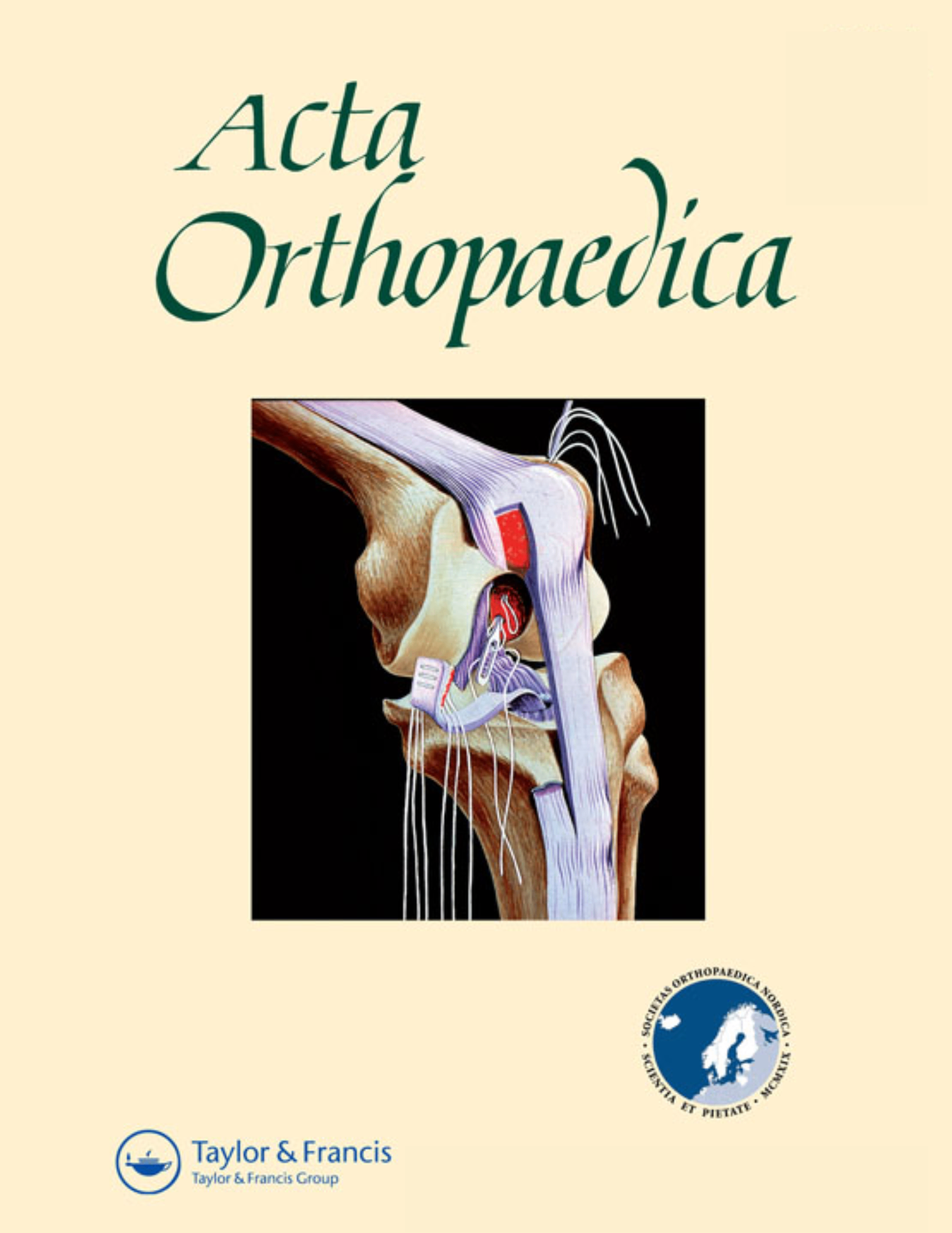
OE Journal. 2013;1(13):1 Acta Orthop. 2013 Jun;84(3):246-53. doi: 10.3109/17453674.2013.788435. Epub 2013 Mar 2676 patients with primary osteoarthritis and secondary osteoarthritis due to mild dysplasia were randomized to receive either standard total hip arthroplasty (THA), large-head THA, or resurfacing hip arthroplasty (RHA) to examine the differences between these three treatments on long-term clinical function. Results at 2 years indicated that, although incision length and surgical time were significantly higher in the RHA group, there were no significant differences between groups in range of motion, Harris Hip scores (HHS), Western Ontario and McMaster Universities Osteoarthritis Index (WOMAC) scores, UCLA activity scores, step rate or sick leave. There was no clinically relevant difference between groups in quality of life.
Was the allocation sequence adequately generated?
Was allocation adequately concealed?
Blinding Treatment Providers: Was knowledge of the allocated interventions adequately prevented?
Blinding Outcome Assessors: Was knowledge of the allocated interventions adequately prevented?
Blinding Patients: Was knowledge of the allocated interventions adequately prevented?
Was loss to follow-up (missing outcome data) infrequent?
Are reports of the study free of suggestion of selective outcome reporting?
Were outcomes objective, patient-important and assessed in a manner to limit bias (ie. duplicate assessors, Independent assessors)?
Was the sample size sufficiently large to assure a balance of prognosis and sufficiently large number of outcome events?
Was investigator expertise/experience with both treatment and control techniques likely the same (ie.were criteria for surgeon participation/expertise provided)?
Sì = 1
Incerto = 0,5
Non rilevante = 0
No = 0
La valutazione dei criteri di segnalazione valuta la trasparenza con cui gli autori riportano le caratteristiche metodologiche e sperimentali dello studio all'interno della pubblicazione. La valutazione è suddivisa in cinque categorie che vengono presentate di seguito.
4/4
Asignación aleatoria
2/4
Criterios de resultado
4/4
Criterios de inclusión/exclusión
4/4
Descripción del tratamiento
4/4
Estadística
Detsky AS, Naylor CD, O'Rourke K, McGeer AJ, L'Abbé KA. J Clin Epidemiol. 1992;45:255-65
L'Indice di Fragilità è uno strumento che aiuta l'interpretazione dei risultati significativi, fornendo una misura della forza di un risultato. L'Indice di Fragilità rappresenta il numero di eventi consecutivi che devono essere aggiunti a un risultato dicotomico per rendere il risultato non più significativo. Un numero piccolo rappresenta un risultato più debole, mentre un numero grande rappresenta un risultato più forte.
Perché questo studio era necessario ora?
Previous research has found that large-head total hip arthroplasty (THA) or resurfacing hip arthroplasty (RHA) have several advantages when compared to standard THA, namely increased range of motion, decreased patient anxiety and reduced risk of dislocations. In addition, past literature has found that when compared to THA, RHA requires a larger incision, resulting in an immediate disadvantage but no long-term effect on function. However, in order to access the acetabulum, RHA also requires detachment of a section of gluteus maximus and this can cause long-term decreases in function. The present study aimed to compare the effects of standard THA, large-head THA and large-head RHA on long-term patient function.
Qual era la domanda di ricerca principale?
How did large-head RHA and THA compare to standard THA with respect to clinical function, when assessed at 2 years, in patients with primary and secondary osteoarthritis?
Quali erano i risultati importanti?
- There was no significant difference between groups in blood loss (p=0.09), decrease in haemoglobin (p=0.50), length of hospital stay (p=0.80), flexion (p>0.05), internal rotation (p>0.05) and external rotation (p>0.05). Surgical time and incision length were significantly higher in the RHA group (p<0.001).
- At 2 years, there was no significant difference in total range of motion between standard THA and large-head THA (p=0.60) or RHA (p=0.50).
- Adduction, when measured at earlier time points, was significantly improved in the RHA group and large-head THA group, compared to standard THA at 8 weeks (p=0.02) and in the RHA group compared to the standard THA group at 6 months (p=0.03). At subsequent time points, no significant difference was observed between groups (p>0.05).
- Although no significant differences observed at the earlier time points, there was a significant reduction in extension in the large-head THA group compared to the two other groups at 2 years (p<0.01). The same trend was observed in abduction in the RHA group (p=0.02 at 2 years in favour of the two THA groups).
- At one year, all groups had received a HHS in the "excellent" category, with no significant differences between groups at 2 years (p>0.05). UCLA activity scores, WOMAC scores, and step rate were also not significantly different between groups at 2 years (p>0.05).
- Quality of life was similar between groups up until the 2-year follow-up, with the large-head THA group obtaining significantly higher scores (p<0.05). There was no significant difference in sick leave between groups (p=0.80).
- Complications included 1 cup displacement with dislocation and 1 suspected infection in the RHA group, 1 pulmonary embolus following a deep vein thrombosis and 1 incidence of pain and raised metal ion levels in the large-head THA group, as well as 3 dislocations in the standard THA group.
Che cosa devo ricordare di più?
There were no significant differences between standard total hip arthroplasty (THA), large-head THA, or resurfacing hip arthroplasty (RHA) in range of motion, Harris Hip scores (HHS), Western Ontario and McMaster Universities Osteoarthritis Index (WOMAC) scores, UCLA activity scores, step rate or sick leave, when assessed at 2 years. However, surgical time and incision length was significantly higher in the RHA group. Lastly, there was no clinically relevant difference in quality of life at 2 years.
Come influenzerà l'assistenza ai miei pazienti?
The results from this study suggest that standard total hip arthroplasty (THA), large-head THA, and resurfacing hip arthroplasty (RHA) are all comparable treatments in the management of primary and secondary osteoarthritis. It is important to note that this study had a small sample size; although certain trends were observed in the data, it did not have enough power to detect any potential differences. Studies using larger sample sizes are necessary to conclusively determine if differences in clinical function exist between these three treatments. Furthermore, the metal ion concentrations due to the metal-on-metal nature of the resurfacing technique, as well as the adverse events associated with these increased concentrations should be considered when choosing a treatment option.

DISCLAIMER
Il contenuto di questa pagina è solo a scopo informativo e non intende sostituire la consulenza, la diagnosi o il trattamento medico professionale. Se ha bisogno di cure mediche, si rivolga sempre al suo medico o al pronto soccorso più vicino. Le opinioni, le convinzioni e i punti di vista espressi dalle persone sui contenuti presenti in questa pagina non riflettono le opinioni, le convinzioni e i punti di vista di OrthoEvidence.
0 di 4 articoli mensili GRATUITI sbloccati



