










PERI-OPERATIVE
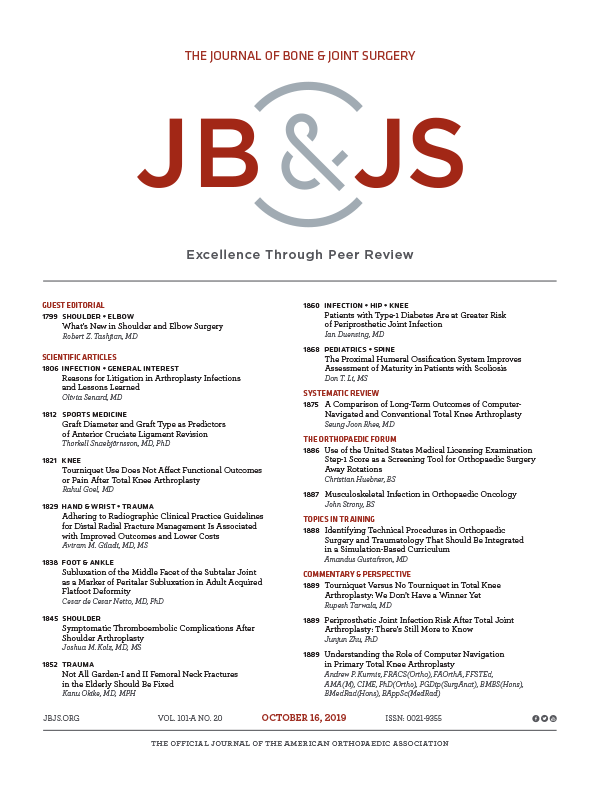
Short-Term Indwelling Foley Catheters Do Not Reduce the Risk of Postoperative Urinary Retention in Uncomplicated Primary THA and TKA: A Randomized Controlled Trial.
 Diese Studie wurde als potentiell hochwirksam eingestuft.
Die KI-gesteuerte High-Impact-Metrik von OE schätzt den Einfluss ein, den eine Arbeit wahrscheinlich haben wird, indem sie Signale sowohl der Zeitschrift, in der sie veröffentlicht wurde, als auch des wissenschaftlichen Inhalts des Artikels selbst integriert.
Das mit Hilfe modernster natürlicher Sprachverarbeitung entwickelte OE High Impact-Modell sagt die zukünftige Zitationsleistung einer Studie genauer voraus als der Impact-Faktor einer Zeitschrift allein.
Dies ermöglicht eine frühere Erkennung von klinisch bedeutsamer Forschung und hilft den Lesern, sich auf Artikel zu konzentrieren, die die zukünftige Praxis am ehesten beeinflussen werden.
Diese Studie wurde als potentiell hochwirksam eingestuft.
Die KI-gesteuerte High-Impact-Metrik von OE schätzt den Einfluss ein, den eine Arbeit wahrscheinlich haben wird, indem sie Signale sowohl der Zeitschrift, in der sie veröffentlicht wurde, als auch des wissenschaftlichen Inhalts des Artikels selbst integriert.
Das mit Hilfe modernster natürlicher Sprachverarbeitung entwickelte OE High Impact-Modell sagt die zukünftige Zitationsleistung einer Studie genauer voraus als der Impact-Faktor einer Zeitschrift allein.
Dies ermöglicht eine frühere Erkennung von klinisch bedeutsamer Forschung und hilft den Lesern, sich auf Artikel zu konzentrieren, die die zukünftige Praxis am ehesten beeinflussen werden.
OrthoEvidence Journal (OE Journal) - ACE Report
OE Journal. 2025;13(6):33 J Bone Joint Surg Am. 2023 Feb 15;105(4):312-319.Zusammenfassung der Studie
Three hundred and eighty-eight patients undergoing primary total knee arthroplasty (TKA) (n=228) or total hip arthroplasty (THA) (n=160) with spinal anesthesia were randomized to receive a short-term Foley catheter (n=194) or no catheter (n=194). The primary outcome of interest was the development of postoperative urinary retention (POUR), defined as requiring at least two straight catheterizations or an indwelling urinary catheter placement due to retention of ≥450 mL on bladder scans. Secondary outcomes included the incidence of urinary tract infections (UTIs) within three weeks and the need for at least one straight catheterization. Outcomes were assessed postoperatively and at three weeks. Overall, the study found no significant difference in the rate of POUR between the Foley catheter and no-catheter groups. Additionally, there was no significant difference in secondary outcomes, including UTI rates and the need for straight catheterization. These findings suggest that short-term Foley catheter use does not provide a benefit in reducing POUR risk and may not be necessary in uncomplicated primary TKA and THA cases.
Vollständigen ACE-Bericht freischalten
Sie haben Zugang zu 4 weiteren KOSTENLOSEN Artikeln in diesem Monat.
Klicken Sie unten, um diese ACE Reports freizuschalten und anzusehen
Jetzt freischalten
Kritische Beurteilungen der neuesten, hochwirksamen randomisierten kontrollierten Studien und systematischen Übersichten in der Orthopädie
Zugang zu OrthoEvidence-Podcast-Inhalten, einschließlich Kooperationen mit dem Journal of Bone and Joint Surgery, Interviews mit international anerkannten Chirurgen und Diskussionsrunden zu orthopädischen Neuigkeiten und Themen
Abonnement von The Pulse, einem zweimal wöchentlich erscheinenden evidenzbasierten Newsletter, der Ihnen helfen soll, bessere klinische Entscheidungen zu treffen
Exklusiver Zugang zu Originalartikeln, einschließlich eigener systematischer Übersichten, sowie zu Artikeln über Methoden der Gesundheitsforschung und aktuelle orthopädische Themen
Oder upgraden Sie noch heute und erhalten Sie Zugang zu allen OrthoEvidence-Inhalten für nur $1,99 pro Woche.
Sie haben bereits ein Konto? Einloggen
Gehören Sie zu einem unserer Partnerverbände?
Klicken Sie hier, um im Rahmen Ihrer Verbandsmitgliedschaft kostenlosen Zugang zu erhalten!



0 von 4 monatliche KOSTENLOSE Artikel freigeschaltet



