










SPINE
Clinical assessment of reformed lumbar microdiscectomy
OrthoEvidence Journal (OE Journal) - ACE Report
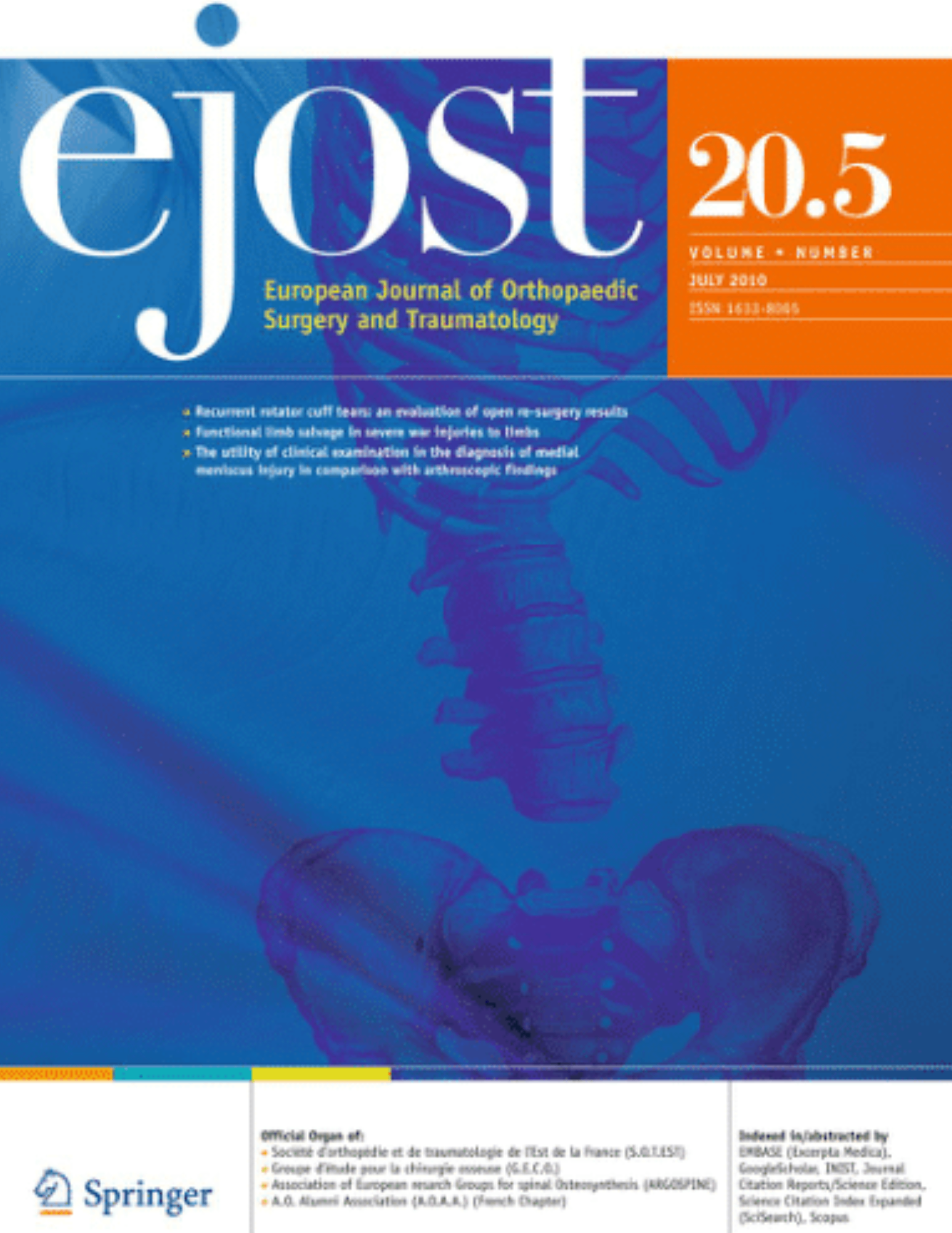
OE Journal. 2014;2(8):33 Eur J Orthop Surg Traumatol. 2014 Jan;24(1):23-7. doi: 10.1007/s00590-012-1123-8. Epub 2012 Nov 2497 patients with unilateral lumbar disc herniation were randomized to undergo lumbar microdiscectomy using either a traditional (control) or revised (test) technique, which focused on preserving as much of the ligamentum flavum as possible. The purpose of this study was to compare these two surgical approaches with respect to operative time, blood loss, pain and function. Results indicated that, although there were no significant differences between groups with respect to leg pain, operative time or blood loss, the test group yielded significantly better Oswestry scores at 12 weeks and 1 year post-operation. The revised procedure also resulted in significantly lower back pain scores at 3 days and 12 weeks postoperatively, however this significance was not maintained at 1 year. Both procedures were demonstrated to be safe, with no reports of reherniation, re-operation or infection.
Was the allocation sequence adequately generated?
Was allocation adequately concealed?
Blinding Treatment Providers: Was knowledge of the allocated interventions adequately prevented?
Blinding Outcome Assessors: Was knowledge of the allocated interventions adequately prevented?
Blinding Patients: Was knowledge of the allocated interventions adequately prevented?
Was loss to follow-up (missing outcome data) infrequent?
Are reports of the study free of suggestion of selective outcome reporting?
Were outcomes objective, patient-important and assessed in a manner to limit bias (ie. duplicate assessors, Independent assessors)?
Was the sample size sufficiently large to assure a balance of prognosis and sufficiently large number of outcome events?
Was investigator expertise/experience with both treatment and control techniques likely the same (ie.were criteria for surgeon participation/expertise provided)?
Sì = 1
Incerto = 0,5
Non rilevante = 0
No = 0
La valutazione dei criteri di segnalazione valuta la trasparenza con cui gli autori riportano le caratteristiche metodologiche e sperimentali dello studio all'interno della pubblicazione. La valutazione è suddivisa in cinque categorie che vengono presentate di seguito.
1/4
Asignación aleatoria
2/4
Criterios de resultado
1/4
Criterios de inclusión/exclusión
4/4
Descripción del tratamiento
3/4
Estadística
Detsky AS, Naylor CD, O'Rourke K, McGeer AJ, L'Abbé KA. J Clin Epidemiol. 1992;45:255-65
L'Indice di Fragilità è uno strumento che aiuta l'interpretazione dei risultati significativi, fornendo una misura della forza di un risultato. L'Indice di Fragilità rappresenta il numero di eventi consecutivi che devono essere aggiunti a un risultato dicotomico per rendere il risultato non più significativo. Un numero piccolo rappresenta un risultato più debole, mentre un numero grande rappresenta un risultato più forte.
Perché questo studio era necessario ora?
Lumbar microdiscectomy was first introduced for the surgical treatment of herniated discs, due to its ability to result in a shorter incision and less trauma, bleeding and postoperative pain compared to classic surgical procedures. Today, this less-invasive technique is considered to be standard for patients with this condition and for whom conservative treatment is unsuccessful. This procedure, however, is continuously being revised in hopes of sparing the ligamentum flavum, as well as to address any drawbacks with current techniques of ligamentum flavum preservation. This study was needed to evaluate the clinical outcomes associated with a revised lumbar microdiscectomy procedure, where only the ligamentum flavum that affected surgical exposure (or that may cause disease later on) was removed.
Qual era la domanda di ricerca principale?
Is a reformed lumbar mircodiscectomy procedure - where only the ligamentum flavum that affected surgical exposure (or that may cause disease later on) was removed - clinically efficacious when compared to traditional lumbar microdiscectomy and assessed over 1 year postoperatively?
Quali erano i risultati importanti?
- Surgical time was 46 +/- 25 minutes in the test group and 42 +/- 20 minutes in the control group, and blood loss was 50 mL in both groups.
- Although significant improvements were observed in both groups, patients in the test group displayed significantly better VAS low back pain scores compared to the control group at 3 days (1.8 vs 3.8) and 12 weeks post-operation (1.3 vs 3.5) (both p<0.05). The difference between groups at 1 year was not statistically significant (test group: 1.9 points; control group: 2.8 points; p>0.05).
- There was no significant difference in VAS leg pain between groups at either 3 days (test group: 2.3; control group: 2.1), 12 weeks (test group: 1.9; control group: 2.0), or 1 year (test group: 1.8; control group: 1.7) post-operation (all p>0.05).
- Although significant improvements were observed in both groups, Oswestry scores were significantly better in the test group versus the control group at 12 weeks (18.2 vs. 34.4) and 1 year (12.0 vs. 22.6) post-operation (both p<0.05).
- There was no incidence of recurrent disc herniation, re-operation, wound infection, or intervertebral gap infection in either group.
Che cosa devo ricordare di più?
Although there was no significant difference between groups with respect to leg pain, operative time or blood loss, the revised lumbar microdiscectomy procedure yielded significantly better Oswestry scores at 12 weeks and 1 year post-operation compared to the traditional lumbar microdiscectomy for patients with disc herniation. The revised procedure also resulted in significantly lower back pain scores at 3 days and 12 weeks postoperatively. Both procedures proved to be safe, with no reports of recurring disc herniation, re-operation or infection.
Come influenzerà l'assistenza ai miei pazienti?
Results from this study suggest that a revised lumbar microdiscectomy procedure, where the ligamenta flava is preserved as much as possible, may be more beneficial than the traditional procedure, especially with respect to lumbar function and back pain. Future studies should compare these two procedures using larger sample sizes, longer follow-up periods, and more rigorous assessment of outcome.

DISCLAIMER
Il contenuto di questa pagina è solo a scopo informativo e non intende sostituire la consulenza, la diagnosi o il trattamento medico professionale. Se ha bisogno di cure mediche, si rivolga sempre al suo medico o al pronto soccorso più vicino. Le opinioni, le convinzioni e i punti di vista espressi dalle persone sui contenuti presenti in questa pagina non riflettono le opinioni, le convinzioni e i punti di vista di OrthoEvidence.
0 di 4 articoli mensili GRATUITI sbloccati



