










SHOULDER & ELBOW
Pectoralis major pedicle bone grafting vs. tricortical iliac grafting for Neer 4-part proximal humerus fractures: a randomized controlled trial.
OrthoEvidence Journal (OE Journal) - ACE Report
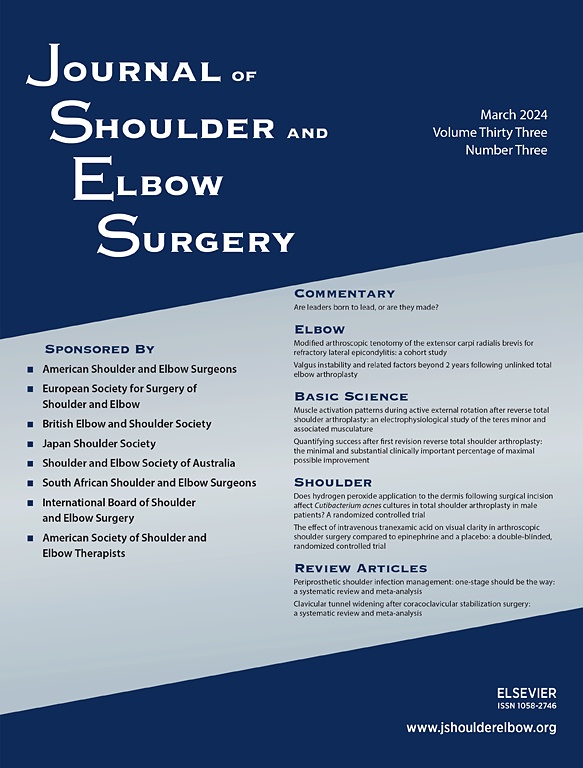
OE Journal. 2024;12(5):13 J Shoulder Elbow Surg . 2024 Jan;33(1):14-22.Zusammenfassung der Studie
In this randomized controlled trial, 34 patients with Neer 4-part proximal humerus fractures (aged 50-75) were randomly assigned to receive either plate osteosynthesis with a vascularized pectoralis major graft (Group A, n=17) or tricortical iliac grafting (Group B, n=17). The primary outcome was reduction loss, and secondary outcomes included humeral parameters (humeral neck shaft angle, humeral head height, avascular necrosis) and functional assessments (Constant Score and American Shoulder and Elbow Surgeons score). Group A showed significantly less reduction loss (17.6% vs. 58.8%, P=0.013). There was a lower rate of humeral head avascular necrosis in Group A (5.8% vs. 29.4%, P=0.071) than in Group B, which trended towards statistical significance. Constant scores were not statistically significant between groups. American Shoulder and Elbow Surgeons scores were statistically higher in Group A at 3, 6 and 24 months post-procedure. Thus, the technique with the pectoralis major graft demonstrated favorable clinical and radiological results without additional donor site morbidity, suggesting its potential advantages in treating Neer 4-part proximal humerus fractures.
Vollständigen ACE-Bericht freischalten
Sie haben Zugang zu 4 weiteren KOSTENLOSEN Artikeln in diesem Monat.
Klicken Sie unten, um diese ACE Reports freizuschalten und anzusehen
Jetzt freischalten
Kritische Beurteilungen der neuesten, hochwirksamen randomisierten kontrollierten Studien und systematischen Übersichten in der Orthopädie
Zugang zu OrthoEvidence-Podcast-Inhalten, einschließlich Kooperationen mit dem Journal of Bone and Joint Surgery, Interviews mit international anerkannten Chirurgen und Diskussionsrunden zu orthopädischen Neuigkeiten und Themen
Abonnement von The Pulse, einem zweimal wöchentlich erscheinenden evidenzbasierten Newsletter, der Ihnen helfen soll, bessere klinische Entscheidungen zu treffen
Exklusiver Zugang zu Originalartikeln, einschließlich eigener systematischer Übersichten, sowie zu Artikeln über Methoden der Gesundheitsforschung und aktuelle orthopädische Themen
Oder upgraden Sie noch heute und erhalten Sie Zugang zu allen OrthoEvidence-Inhalten für nur $1,99 pro Woche.
Sie haben bereits ein Konto? Einloggen
Gehören Sie zu einem unserer Partnerverbände?
Klicken Sie hier, um im Rahmen Ihrer Verbandsmitgliedschaft kostenlosen Zugang zu erhalten!


0 von 4 monatliche KOSTENLOSE Artikel freigeschaltet



