










FOOT & ANKLE
Displaced intra-articular calcaneal fractures treated in a minimally invasive fashion: longitudinal approach versus sinus tarsi approach
OrthoEvidence Journal (OE Journal) - ACE Report
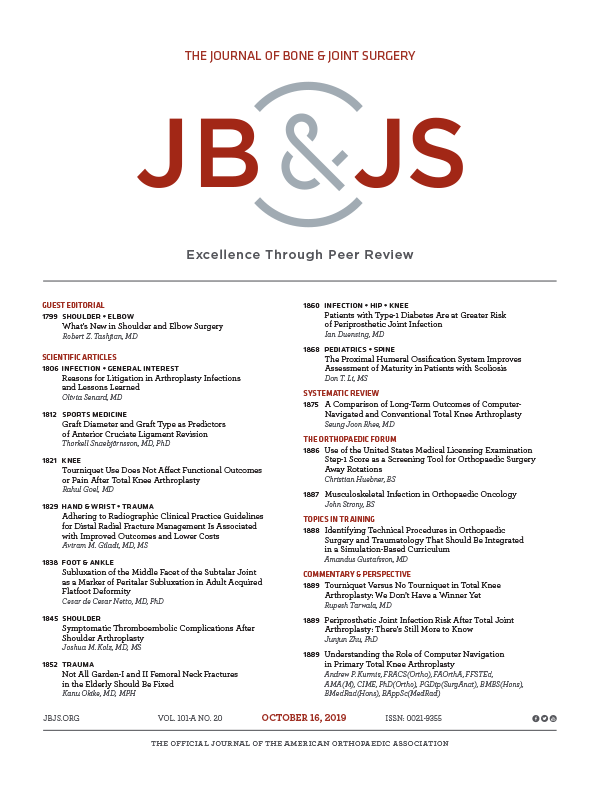
OE Journal. 2014;2(12):29 J Bone Joint Surg Am. 2014 Feb 19;96(4):302-9. doi: 10.2106/JBJS.L.01215167 patients with displaced intra-articular calcaneal fractures were randomized to surgery using either a minimally invasive longitudinal approach (MILA) or sinus tarsi approach (STA). The purpose was to compare functional and radiographic outcomes, as well as the incidence of complications. In Sanders type II and III fractures, the MILA was associated with similar functional and radiographic outcomes to that achieved with STA. However, STA was associated with better outcome in Sanders type IV fractures. Overall, the incidence of wound-healing complications was lower with MILA.
Unlock the Full ACE Report
You have access to 4 more FREE articles this month.
Click below to unlock and view this ACE Reports
Unlock Now
Critical appraisals of the latest, high-impact randomized controlled trials and systematic reviews in orthopaedics
Access to OrthoEvidence podcast content, including collaborations with the Journal of Bone and Joint Surgery, interviews with internationally recognized surgeons, and roundtable discussions on orthopaedic news and topics
Subscription to The Pulse, a twice-weekly evidence-based newsletter designed to help you make better clinical decisions
Exclusive access to original content articles, including in-house systematic reviews, and articles on health research methods and hot orthopaedic topics
Or upgrade today and gain access to all OrthoEvidencecontent for as little as $1.99 per week.
Already have an account? Log in
Are you affiliated with one of our partner associations?
Click here to gain complimentary access as part your association member benefits!



0 of 4 monthly FREE articles unlocked



