










GENERAL ORTHOPAEDICS
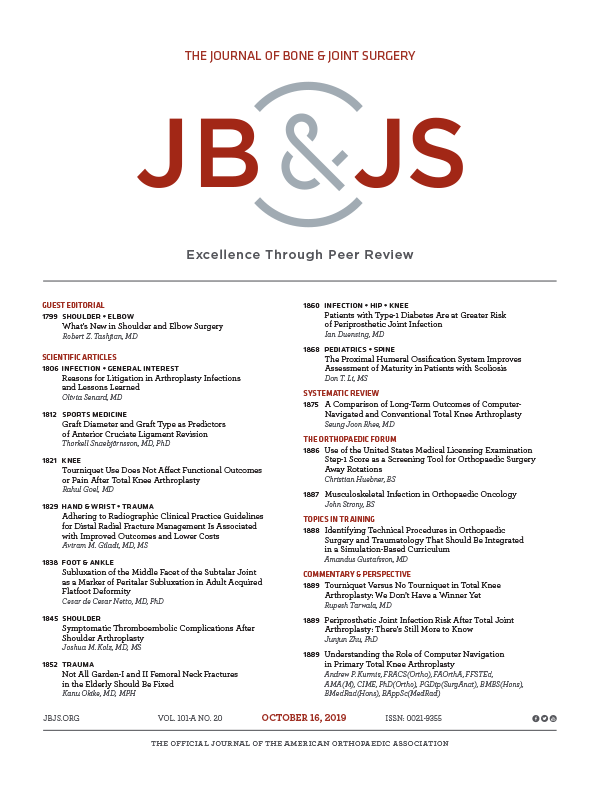
Focused Shockwave Treatment for Greater Trochanteric Pain Syndrome: A Multicenter, Randomized, Controlled Clinical Trial
 Este estudo foi identificado como tendo um impacto potencialmente elevado.
A métrica de Alto Impacto da OE, baseada em IA, estima a influência que um artigo poderá ter, integrando sinais da revista em que é publicado e do conteúdo científico do próprio artigo.
Desenvolvido com recurso ao mais avançado processamento de linguagem natural, o modelo High Impact da OE prevê com maior precisão o desempenho futuro de um estudo em termos de citações do que o fator de impacto da revista por si só.
Isto permite o reconhecimento precoce de investigação clinicamente significativa e ajuda os leitores a concentrarem-se nos artigos com maior probabilidade de moldar a prática futura.
Este estudo foi identificado como tendo um impacto potencialmente elevado.
A métrica de Alto Impacto da OE, baseada em IA, estima a influência que um artigo poderá ter, integrando sinais da revista em que é publicado e do conteúdo científico do próprio artigo.
Desenvolvido com recurso ao mais avançado processamento de linguagem natural, o modelo High Impact da OE prevê com maior precisão o desempenho futuro de um estudo em termos de citações do que o fator de impacto da revista por si só.
Isto permite o reconhecimento precoce de investigação clinicamente significativa e ajuda os leitores a concentrarem-se nos artigos com maior probabilidade de moldar a prática futura.
OrthoEvidence Journal (OE Journal) - ACE Report
OE Journal. 2021;9(7):8 J Bone Joint Surg Am. 2020 Aug 5;102(15): 1305-1311.Resumo do estudo
One hundred and three patients with unilateral chronic greater trochanteric pain syndrome (GTPS) were randomized to receive electromagnetic focused extracorporeal shockwave treatment (F-ESWT) with a specific exercise protocol or sham F-ESWT with the same exercise protocol. The primary outcome of interest included pain measured using the visual analogue scale (VAS) at 2-months follow-up. Secondary outcomes included the Harris Hip Score (HHS), the Lower Extremity Functional Scale (LEFS), EuroQoL-5 Dimensions Questionnaire (EQ-5D), and the Roles and Maudsley score. As well, incidence of complications were also measured. All secondary outcomes were measured at 1, 2, 3, and 6 months post-intervention. Results revealed that mean VAS was statistically significantly lower in the F-ESWT group compared to the sham (p<0.001) at 2-months follow-up. Furthermore, HHS, RM, and EQ-5D scores were statistically significantly improved in the F-ESWT group at all timepoints (p<0.05 for all). LEFS scores were statistically significantly improved at all timepoints in the F-ESWT group except for at 1-month follow-up (p=0.25). Finally, no complications were observed in either group.
Desbloqueie o relatório completo da ACE
Tem acesso a 4 mais artigos GRATUITOS este mês.
Clique abaixo para desbloquear e ver este ACE Reports
Desbloqueie agora
Avaliações críticas dos mais recentes ensaios clínicos aleatórios de alto impacto e revisões sistemáticas em ortopedia
Acesso ao conteúdo do podcast OrthoEvidence, incluindo colaborações com o Journal of Bone and Joint Surgery, entrevistas com cirurgiões reconhecidos internacionalmente e discussões em mesa redonda sobre notícias e tópicos ortopédicos
Subscrição do The Pulse, um boletim informativo duas vezes por semana baseado em evidências, concebido para o ajudar a tomar melhores decisões clínicas
Acesso exclusivo a artigos de conteúdo original, incluindo revisões sistemáticas internas e artigos sobre métodos de investigação em saúde e tópicos ortopédicos importantes
Ou actualize hoje e obtenha acesso a todo o conteúdo da OrthoEvidence por apenas $1,99 por semana.
Já tem uma conta? Inicie sessão
Está afiliado a uma das nossas associações parceiras?
Clique aqui para obter acesso gratuito como parte dos benefícios de membro da sua associação!


Subscreva a "O Pulso"
Ortopedia baseada em evidências diretamente para a sua caixa de correio. SUBSCREVA-SE
0 de 4 artigos mensais GRATUITOS desbloqueados



