










HAND & WRIST
Blood Flow Restriction Therapy after Closed Treatment of Distal Radius Fractures
OrthoEvidence Journal (OE Journal) - ACE Report
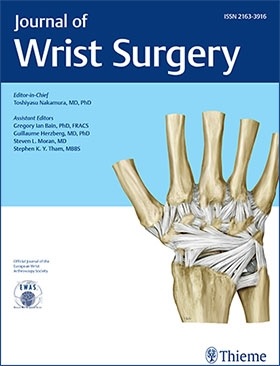
OE Journal. 2020;8(16):8 J Wrist Surg. 2019 Aug;8(4):288-294.Thirteen patients scheduled for closed reduction for the treatment of a displaced distal radius fracture were randomized to receive a distal radius fracture rehabilitation program with or without the use of a tourniquet for blood flow restriction. The outcomes of interest included pain during rest and activity (measured on a Visual Analog Scale (VAS)), grip strength, pinch strength, the patient reported wrist evaluation (PRWE), the Disability of the Arm, Shoulder and Hand (DASH) score and radiological assessments (radial height, radial inclination, ulnar variance, tear drop angle, articular diastasis, volar tilt). Clinical evaluation was performed 4 and 8 weeks after the initiation of rehabilitation, which began 6 weeks after closed reduction and subsequent casting. The results of the study revealed no significant differences between the blood flow restriction and no blood flow restriction groups in all outcomes, at all time points. However, the change from baseline in VAS pain during activity and PRWE score was significantly in favour of the blood flow restriction group.
Vollständigen ACE-Bericht freischalten
Sie haben Zugang zu 4 weiteren KOSTENLOSEN Artikeln in diesem Monat.
Klicken Sie unten, um diese ACE Reports freizuschalten und anzusehen
Jetzt freischalten
Kritische Beurteilungen der neuesten, hochwirksamen randomisierten kontrollierten Studien und systematischen Übersichten in der Orthopädie
Zugang zu OrthoEvidence-Podcast-Inhalten, einschließlich Kooperationen mit dem Journal of Bone and Joint Surgery, Interviews mit international anerkannten Chirurgen und Diskussionsrunden zu orthopädischen Neuigkeiten und Themen
Abonnement von The Pulse, einem zweimal wöchentlich erscheinenden evidenzbasierten Newsletter, der Ihnen helfen soll, bessere klinische Entscheidungen zu treffen
Exklusiver Zugang zu Originalartikeln, einschließlich eigener systematischer Übersichten, sowie zu Artikeln über Methoden der Gesundheitsforschung und aktuelle orthopädische Themen
Oder upgraden Sie noch heute und erhalten Sie Zugang zu allen OrthoEvidence-Inhalten für nur $1,99 pro Woche.
Sie haben bereits ein Konto? Einloggen
Gehören Sie zu einem unserer Partnerverbände?
Klicken Sie hier, um im Rahmen Ihrer Verbandsmitgliedschaft kostenlosen Zugang zu erhalten!



0 von 4 monatliche KOSTENLOSE Artikel freigeschaltet



