










SPINE
Results of cervical arthroplasty compared with anterior discectomy and fusion: four-year clinical outcomes in a prospective, randomized controlled trial
OrthoEvidence Journal (OE Journal) - ACE Report
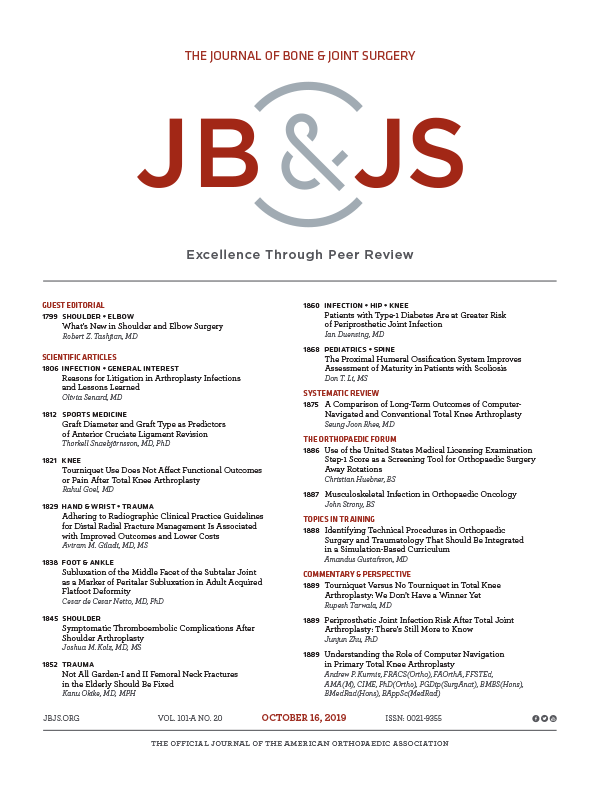
OE Journal. 2013;1(19):42 J Bone Joint Surg Am. 2011 Sep 21;93(18):1684-92. doi: 10.2106/JBJS.J.00476463 patients suffering from single-level degenerative disc disease were included in this trial to compare the outcomes of cervical disc arthroplasty and anterior cervical discectomy and fusion (ACDF). This publication aimed to assess the midterm safety and effectiveness of the Bryan cervical disc arthroplasty. 463 patients were randomized to receive either the Bryan disc or anterior cervical discectomy and fusion. The assessment at 48 months revealed that the cervical disc arthroplasty led to superior results in terms of pain, function, and overall success when compared to ACDF.
Was the allocation sequence adequately generated?
Was allocation adequately concealed?
Blinding Treatment Providers: Was knowledge of the allocated interventions adequately prevented?
Blinding Outcome Assessors: Was knowledge of the allocated interventions adequately prevented?
Blinding Patients: Was knowledge of the allocated interventions adequately prevented?
Was loss to follow-up (missing outcome data) infrequent?
Are reports of the study free of suggestion of selective outcome reporting?
Were outcomes objective, patient-important and assessed in a manner to limit bias (ie. duplicate assessors, Independent assessors)?
Was the sample size sufficiently large to assure a balance of prognosis and sufficiently large number of outcome events?
Was investigator expertise/experience with both treatment and control techniques likely the same (ie.were criteria for surgeon participation/expertise provided)?
Sì = 1
Incerto = 0,5
Non rilevante = 0
No = 0
La valutazione dei criteri di segnalazione valuta la trasparenza con cui gli autori riportano le caratteristiche metodologiche e sperimentali dello studio all'interno della pubblicazione. La valutazione è suddivisa in cinque categorie che vengono presentate di seguito.
1/4
Asignación aleatoria
2/4
Criterios de resultado
2/4
Criterios de inclusión/exclusión
0/4
Descripción del tratamiento
3/4
Estadística
Detsky AS, Naylor CD, O'Rourke K, McGeer AJ, L'Abbé KA. J Clin Epidemiol. 1992;45:255-65
L'Indice di Fragilità è uno strumento che aiuta l'interpretazione dei risultati significativi, fornendo una misura della forza di un risultato. L'Indice di Fragilità rappresenta il numero di eventi consecutivi che devono essere aggiunti a un risultato dicotomico per rendere il risultato non più significativo. Un numero piccolo rappresenta un risultato più debole, mentre un numero grande rappresenta un risultato più forte.
Perché questo studio era necessario ora?
Cervical arthroplasty can be an alternate treatment option to anterior cervical discectomy and fusion for patients suffering from single-level degenerative disc disease. A previous publication by the same authors reported the 2 year results from a trial that compared the Bryan cervical disc arthroplasty with anterior cervical discectomy and fusion. While cervical disc arthroplasty lead to better overall success, a longer follow-up study was required. Thus, this publication aimed to compare the 4 year clinical and functional outcomes of cervical disc arthroplasty versus cervical discectomy and fusion from the same trial.
Qual era la domanda di ricerca principale?
Which method - cervical spine arthroplasty or anterior cervical discectomy and fusion - led to better overall success for the treatment of radiculopathy or myelopathy caused by single-level cervical disc disease, assessed at 48 months?
Quali erano i risultati importanti?
- At 4 years, the overall success was better in the arthroplasty group (85.1%) compared to the fusion group (72.5%) (P = 0.004).
- At 4 years, the mean NDI was lower in the arthroplasty group (13.2 (95% CI: 10.9 to 15.6)) in comparison to the fusion group (19.8 (95% CI: 16.5 to 23.2), P < 0.001).
- In terms of neurological success, the mean rates were 92.8% for the arthroplasty group and 89.9% for the fusion group; there was no significant difference (P > 0.05).
- The arm pain score improved rapidly for both groups, from a preoperative score of 71.2 in both groups to 16.6 (95% CI: 13.1 to 20.2) in the arthroplasty group and to 22.4 (95% CI: 17.7 to 27.1) in the fusion group at 4 years; the improvement was significantly better in the arthroplasty group (P = 0.028).
- Neck pain improved from 75.4 to 20.7 (95% CI: 17.0 to 24.4) in the arthroplasty group and from 74.8 to 30.6 (95% CI: 25.5 to 35.8) in the fusion group at 4 years; the improvement was significantly greater in the arthroplasty group at all time points (P < 0.05).
- At 4 years, the mean SF-36 physical component score improvement was significantly better (P = 0.007) in the arthroplasty group (from 32.6 to 48.4 (95% CI: 46.8 to 49.9) compared to the fusion group (from 31.8 to 44.9 (95% CI: 43.0 to 46.9).
- The rates of total and serious adverse events were similar between both groups.
Che cosa devo ricordare di più?
This study demonstrated that cervical disc arthroplasty continued to provide superior results at 4 years in comparison to anterior cervical discectomy and fusion. The arthroplasty treatment led to significantly higher rate of overall success and greater improvements in NDI, neck and arm pain, and SF-36 physical component scores.
Come influenzerà l'assistenza ai miei pazienti?
This study suggests that cervical disc arthroplasty provides better clinical improvement compared to cervical fusion. However, a longer-term follow-up study is required in order to investigate the potential problems related to bearing surface wear. Additionally, an assessment of adjacent-level disc degeneration and secondary surgeries should be conducted in the long-term follow-up.

DISCLAIMER
Il contenuto di questa pagina è solo a scopo informativo e non intende sostituire la consulenza, la diagnosi o il trattamento medico professionale. Se ha bisogno di cure mediche, si rivolga sempre al suo medico o al pronto soccorso più vicino. Le opinioni, le convinzioni e i punti di vista espressi dalle persone sui contenuti presenti in questa pagina non riflettono le opinioni, le convinzioni e i punti di vista di OrthoEvidence.
0 di 4 articoli mensili GRATUITI sbloccati



