










SHOULDER & ELBOW
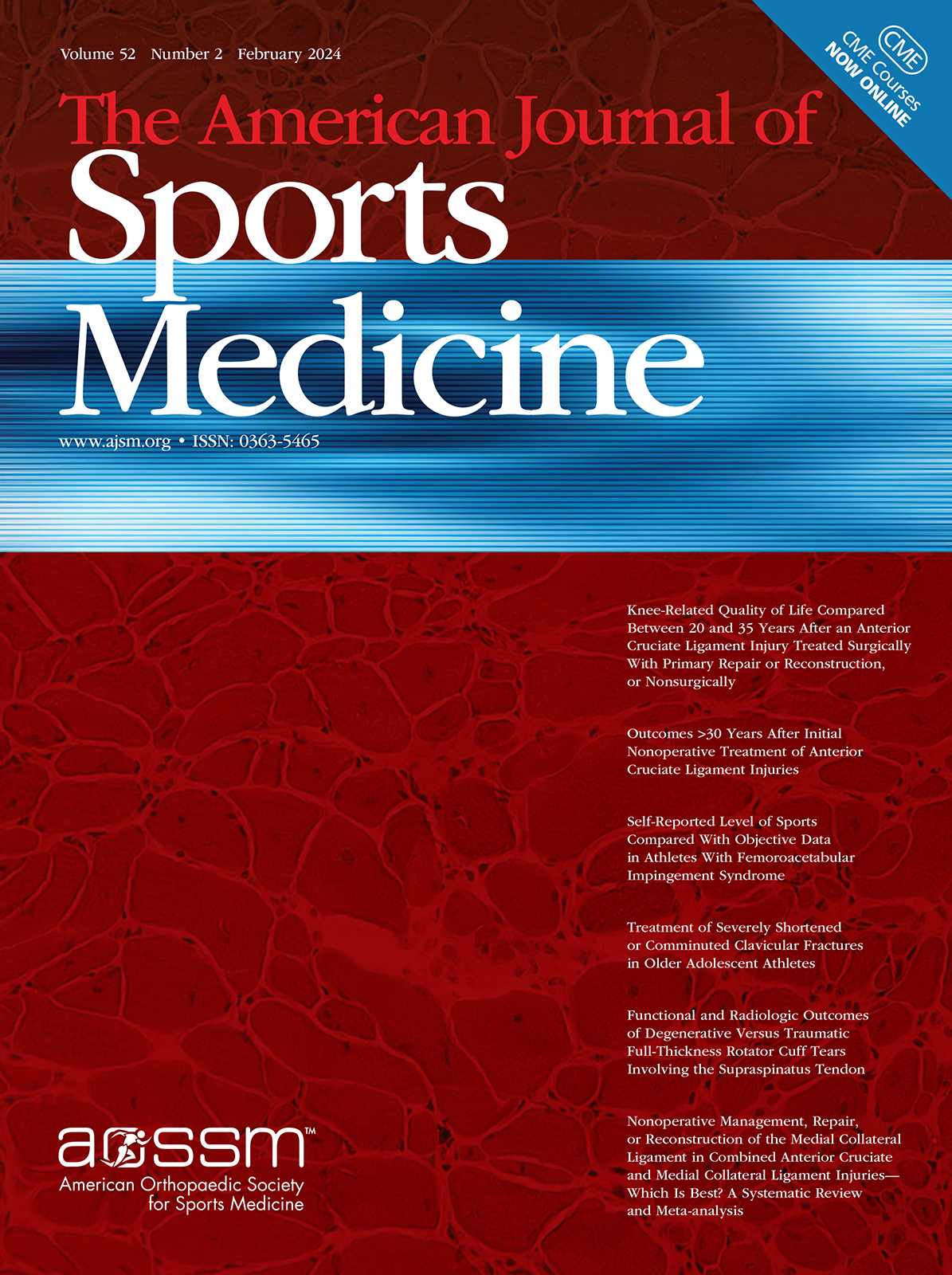
Arthroscopic Bankart Repair Versus Immobilization for a First Episode of an Anterior Shoulder Dislocation Before the Age of 25 Years: A Randomized Controlled Trial With 6-Year Follow-up.
 This study has been identified as potentially high impact.
OE's AI-driven High Impact metric estimates the influence a paper is likely to have by integrating signals from both the journal in which it is published and the scientific content of the article itself.
Developed using state-of-the-art natural language processing, the OE High Impact model more accurately predicts a study's future citation performance than journal impact factor alone.
This enables earlier recognition of clinically meaningful research and helps readers focus on articles most likely to shape future practice.
This study has been identified as potentially high impact.
OE's AI-driven High Impact metric estimates the influence a paper is likely to have by integrating signals from both the journal in which it is published and the scientific content of the article itself.
Developed using state-of-the-art natural language processing, the OE High Impact model more accurately predicts a study's future citation performance than journal impact factor alone.
This enables earlier recognition of clinically meaningful research and helps readers focus on articles most likely to shape future practice.
OrthoEvidence Journal (OE Journal) - ACE Report
OE Journal. 2026;14(12):59 Am J Sports Med. 2025 Aug;53(10):2289-2297.Study Summary
40 patients between the ages of 18-and-25 years with first episode of an anterior shoulder dislocation (ASD) were randomised to either receive Arthroscopic Bankart Repair (n=20) or immobilization treatment (n=20). The primary outcome of interest was recurrence of instability or another ASD. The secondary outcomes of interest were Disabilities of the Arm, Shoulder and Hand (Quick DASH), Walch-Duplay score, and Western Ontario Shoulder Instability Index (WOSI), return to sport and need for stabilization surgery. The results of the study revealed that at 6-year follow-up, the surgical group had a significantly lower rate of recurrent shoulder instability compared to the nonoperative group. Also, complete dislocations were more frequent in the nonoperative group, and the need for primary or secondary shoulder stabilization surgery was significantly higher in the nonoperative group. Functional outcomes, including Quick DASH and WOSI scores and Walch-Duplay scores for stability, mobility and pain, were significantly better in the surgical group. Lastly, the rate of return to sports was significantly higher in the surgical group compared to the nonoperative group, while there was no significant difference in the incidence of adverse events.
Unlock the Full ACE Report
You have access to 4 more FREE articles this month.
Click below to unlock and view this ACE Reports
Unlock Now
Critical appraisals of the latest, high-impact randomized controlled trials and systematic reviews in orthopaedics
Access to OrthoEvidence podcast content, including collaborations with the Journal of Bone and Joint Surgery, interviews with internationally recognized surgeons, and roundtable discussions on orthopaedic news and topics
Subscription to The Pulse, a twice-weekly evidence-based newsletter designed to help you make better clinical decisions
Exclusive access to original content articles, including in-house systematic reviews, and articles on health research methods and hot orthopaedic topics
Or upgrade today and gain access to all OrthoEvidencecontent for as little as $1.99 per week.
Already have an account? Log in
Are you affiliated with one of our partner associations?
Click here to gain complimentary access as part your association member benefits!


0 of 4 monthly FREE articles unlocked



