










SHOULDER & ELBOW
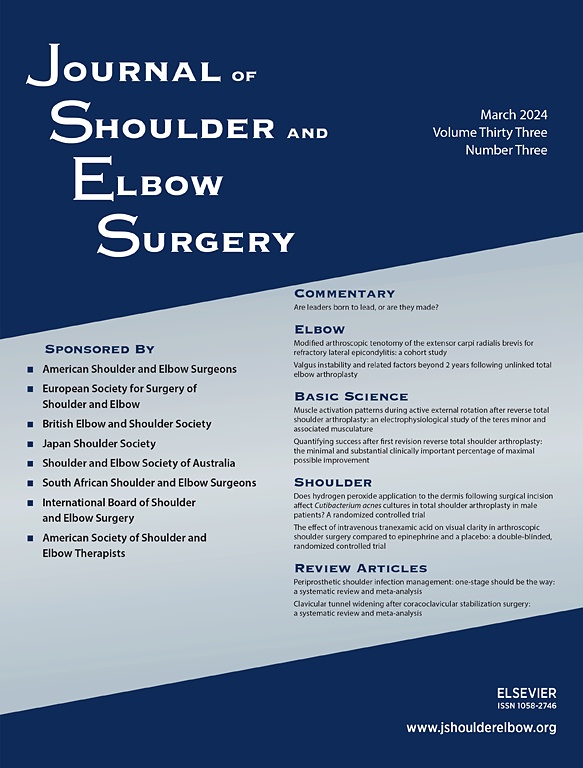
Is the stemless humeral head replacement clinically and radiographically a secure equivalent to standard stem humeral head replacement in the long-term follow-up? A prospective randomized trial.
OrthoEvidence Journal (OE Journal) - ACE Report
OE Journal. 2018;6(9):12 J Shoulder Elbow Surg. 2017 Feb;26(2):225-23240 patients scheduled for total shoulder arthroplasty were randomized to either a stemless implant or a standard stemmed implant. Clinical and radiographic outcomes were assessed over 5-year follow-up. After 5 years, Constant scores did not significantly differ between groups. No cases of radiographic changes either inferior to the humeral component on the anteroposterior view or posterior to the humeral component on the axillary view were observed in the stemless group, which was significantly lower than the incidence observed in the stemmed group.
Was the allocation sequence adequately generated?
Was allocation adequately concealed?
Blinding Treatment Providers: Was knowledge of the allocated interventions adequately prevented?
Blinding Outcome Assessors: Was knowledge of the allocated interventions adequately prevented?
Blinding Patients: Was knowledge of the allocated interventions adequately prevented?
Was loss to follow-up (missing outcome data) infrequent?
Are reports of the study free of suggestion of selective outcome reporting?
Were outcomes objective, patient-important and assessed in a manner to limit bias (ie. duplicate assessors, Independent assessors)?
Was the sample size sufficiently large to assure a balance of prognosis and sufficiently large number of outcome events?
Was investigator expertise/experience with both treatment and control techniques likely the same (ie.were criteria for surgeon participation/expertise provided)?
نعم = 1
غير مؤكد = 0.5
غير ذي صلة = 0
لا = 0
يقيّم تقييم معايير الإبلاغ الشفافية التي يبلغ بها المؤلفون عن الخصائص المنهجية والتجريبية للتجربة في المنشور. ينقسم التقييم إلى خمس فئات معروضة أدناه.
4/4
Randomization
4/4
Outcome Measurements
4/4
Inclusion / Exclusion
4/4
Therapy Description
2/4
Statistics
Detsky AS, Naylor CD, O'Rourke K, McGeer AJ, L'Abbé KA. J Clin Epidemiol. 1992;45:255-65
مؤشر الهشاشة هو أداة تساعد في تفسير النتائج المهمة، وتوفر مقياسًا لقوة النتيجة. ويمثل مؤشر الهشاشة عدد الأحداث المتتالية التي يجب إضافتها إلى نتيجة ثنائية التفرع لجعل النتيجة غير مهمة. يمثل الرقم الصغير نتيجة أضعف ويمثل الرقم الكبير نتيجة أقوى.
لماذا كانت هناك حاجة لهذه الدراسة الآن؟
Interest in stemless humeral head implants for use in shoulder arthroplasty has increased over the past decade. Advocates of stemless humeral head replacements suggest that they offer more anatomical reconstruction of the glenohumeral joint, as well as preserve bone stock if revision is necessary. However, further randomized controlled trials were needed to compare radiographic and clinical outcomes between stemless and stemmed humeral heads in shoulder arthroplasty.
ما هو سؤال البحث الرئيسي؟
In total shoulder arthroplasty, is there any significant difference in clinical and radiographic outcome after 2 or 5 years between a stemless implant and standard stemmed implant?
ما هي النتائج المهمة؟
- There was no significant difference between the stemless group and the stemmed group in Constant score at 2 years (65.5+/-15.4 vs. 65.7+/-11.7, respectively; p=0.642) or 5 years (72.8+/-11.8 vs. 69.9+/-15.3, respectively; p=0.596).
- There was also no significant difference between groups in the Constant score subcategories of pain, activities of daily living, range of motion, and strength at 2 or 5 years (all p>0.05).
- On the anteroposterior view, a significantly lower number of patients demonstrated grade 1 changes (bone density loss/osteolysis) in the inferior region under the prosthesis in the stemless group (0%) compared to the stemmed group (41.2%) (p=0.009). On the axillary view, a significantly lower number of patients demonstrated either grade 1 or 2 changes (grade 2: radiolucent lines <1mm) posterior to the prosthesis in the stemless group (0%) compared to the stemmed group (grade 1: 23.5%; grade 2: 5.9%) (p=0.046)
- No other significant differences between groups were noted in the incidence of radiographic changes around either the humeral component or glenoid component.
- In the stemless group, two patients demonstrated atraumatic loosening of the glenoid component requiring revision, and one patient had rotator cuff deficiency requiring revision. In the stemmed group, one patient suffered traumatic loosening of the humeral component.
ما الذي يجب أن أتذكره أكثر؟
In total shoulder arthroplasty, the use of a stemless implant was associated with a lower incidence in radiographic changes inferior to the humeral component on the anteroposterior view and posterior to the humeral component on the axillary view when compared to a standard stemmed implant. No significant differences between implant types were observed after 5 years on Constant score.
كيف سيؤثر ذلك على رعاية مرضاي؟
The result of this study suggest that a stemless implant in total shoulder arthroplasty may reduce the incidence in radiographic changes developed around the humeral component at mid-term follow-up when compared to a standard stemmed implant, though this does not appear to significantly affect functional outcome in the mid-term. Continued follow-up is necessary to evaluate long-term radiographic changes and survivorship of the the two types of implants.

تنويه
هذا المحتوى الموجود في هذه الصفحة هو لأغراض إعلامية فقط وليس الغرض منه أن يكون بديلاً عن المشورة الطبية المتخصصة أو التشخيص أو العلاج. إذا كنت بحاجة إلى علاج طبي، اطلب دائمًا مشورة طبيبك أو اذهب إلى أقرب قسم طوارئ إليك. الآراء والمعتقدات ووجهات النظر التي يعبر عنها الأفراد في المحتوى الموجود في هذه الصفحة لا تعكس آراء ومعتقدات ووجهات نظر أورثوإيفيدنس.
0 من 4 مقالات مجانية شهرية غير مقفلة



