




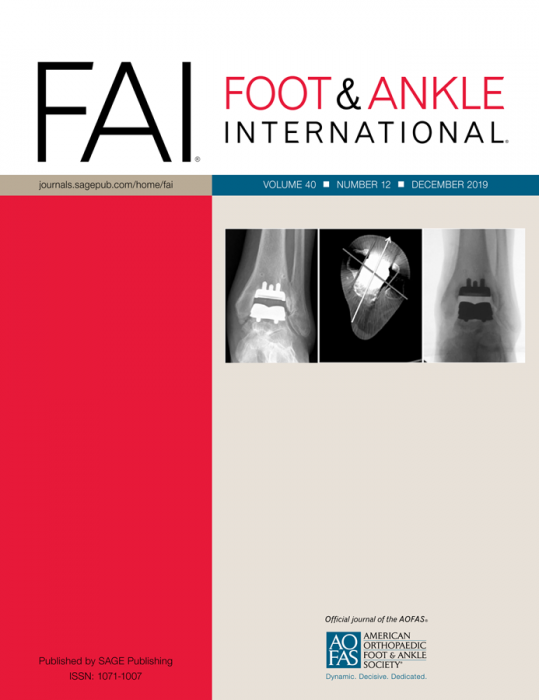






FOOT & ANKLE
A Prospective Pilot Study of B2A-Coated Ceramic Granules (Amplex) Compared to Autograft for Ankle and Hindfoot Arthrodesis
 This report has been verified
by one or more authors of the
original publication.
This report has been verified
by one or more authors of the
original publication.
OrthoEvidence Journal (OE Journal) - ACE Report
OE Journal. 2013;1(9):19 Foot Ankle Int. 2013 Mar 5Exclusive Author Interview
Dr. Glazebrook discusses B2A granules possible autogenous bone graft substitute in foot & ankle arthrodesis surgery
24 patients undergoing foot and ankle arthrodesis surgery were randomized to receive either an autogenous bone graft or B2A-coated ceramic granules. The purpose of this pilot study was to compare the safety and efficacy of each treatment, and determine the feasibility for a larger scale, statistically powered, randomized controlled trial (RCT). Radiographic assessments performed at 6 months demonstrated similar fusion success between groups, at 9 months fusion success was 12/12 in the B2A group and 8/12 in the autograft group. Furthermore, from baseline to 12 months pain and disability Ankle Osteoarthritis Scale (AOS) scores improved similarly, and there were no adverse events related to the graft material reported by any patients. It should be noted that this study was under-powered to detect significant differences between groups.
Was the allocation sequence adequately generated?
Was allocation adequately concealed?
Blinding Treatment Providers: Was knowledge of the allocated interventions adequately prevented?
Blinding Outcome Assessors: Was knowledge of the allocated interventions adequately prevented?
Blinding Patients: Was knowledge of the allocated interventions adequately prevented?
Was loss to follow-up (missing outcome data) infrequent?
Are reports of the study free of suggestion of selective outcome reporting?
Were outcomes objective, patient-important and assessed in a manner to limit bias (ie. duplicate assessors, Independent assessors)?
Was the sample size sufficiently large to assure a balance of prognosis and sufficiently large number of outcome events?
Was investigator expertise/experience with both treatment and control techniques likely the same (ie.were criteria for surgeon participation/expertise provided)?
نعم = 1
غير مؤكد = 0.5
غير ذي صلة = 0
لا = 0
يقيّم تقييم معايير الإبلاغ الشفافية التي يبلغ بها المؤلفون عن الخصائص المنهجية والتجريبية للتجربة في المنشور. ينقسم التقييم إلى خمس فئات معروضة أدناه.
4/4
Asignación aleatoria
3/4
Criterios de resultado
2/4
Criterios de inclusión/exclusión
4/4
Descripción del tratamiento
2/4
Estadística
Detsky AS, Naylor CD, O'Rourke K, McGeer AJ, L'Abbé KA. J Clin Epidemiol. 1992;45:255-65
مؤشر الهشاشة هو أداة تساعد في تفسير النتائج المهمة، وتوفر مقياسًا لقوة النتيجة. ويمثل مؤشر الهشاشة عدد الأحداث المتتالية التي يجب إضافتها إلى نتيجة ثنائية التفرع لجعل النتيجة غير مهمة. يمثل الرقم الصغير نتيجة أضعف ويمثل الرقم الكبير نتيجة أقوى.
لماذا كانت هناك حاجة لهذه الدراسة الآن؟
Ankle arthrodesis is the standard operative treatment method for individuals with end-stage ankle arthritis. Commonly, in this surgical procedure, autogenous bone graft is inserted between joint surfaces to help lower the nonunion rates. However, there is often donor site morbidity associated with autogenous bone grafts, and the correct quantity and quality of grafts is not always available. B2A-coated ceramic granules (B2A, being a synthetic peptide) are a new bone graft extender that have been recently released, and previous research reveals they successfully improved spinal fusion in animals. This study aimed to determine whether B2A-coated ceramic granules were a safe and effective alternative to autogenous bone grafts for foot and ankle arthrodesis surgery.
ما هو سؤال البحث الرئيسي؟
How did the safety and efficacy of B2A-granules compare to autogenous bone graft in patients who underwent foot and ankle arthrodesis surgery, measured over 12 months? Furthermore, did the results of this pilot study encourage larger and better designed RCTs to be conducted on this topic in future?
ما هي النتائج المهمة؟
- At 6 months, the CT scan evaluation indicated that fusion success (percentage joint fusion greater than 50%) was achieved by all patients in the B2A-granule group (12/12 patients=100%) and by 11/12 patients (92%) in the autograft group. At 9 months, all patients in the B2A-granule group still had fusion success, but in the autograft group only 8/12 patients (67%) had fusion success.
- Complete union, defined as greater than 66% of bridging bone in the joint, was achieved in more patients in the B2A-granule group (11/12 patients=92%), compared to the autograft group (8/12 patients=67%). By 9 months 10/12 patients (83%) had complete union in the B2A-granule group, compared to 7/12 patients (58%) in the autograft group.
- The CT scan assessment taken at 6 months revealed that the mean percentage fusion rate was higher in the B2A-granule group (83.7 +/- 12.2%), in comparison to the autograft group (75.2 +/- 22.0%). At 9 months, the mean percentage fusion remained steady for the B2A-granule group, but fell for the autograft group (65.9 +/- 33.8%).
- From baseline to 12 months, pain and disability AOS scores improved for both groups at a similar rate, with the lowest scores obtained at 6 weeks.
- In the autograft group, graft harvest-site pain was reported by 1/11 patients at 6 weeks, 2/12 patients at 3 months, and 2/12 patients at 6 months.
- No complications or adverse events caused by the graft material were reported by any patients. However, 1 patient in the B2A-granule group had a moderately severe wound breakdown, while in the autograft group there was one case of deep vein thrombosis and another of a detached retina.
ما الذي يجب أن أتذكره أكثر؟
At 6 and 9 months fusion success and clinical union rates were overall higher in the B2A-granule group, compared to the autogenous bone graft group. Additionally, there were improvements in pain and disability over 12 months for both groups, and no adverse events related to the graft material were present in any patients. Finally, these results supported the possibility of conducting a larger scale, statistically powered, randomized controlled trial on the safety and efficacy of B2A-granules, compared to autograft in foot and ankle arthrodesis surgery.
كيف سيؤثر ذلك على رعاية مرضاي؟
The high fusion success and complete union rates, improved pain and disability, and absence of adverse events seen with the use of B2A-granules, encourage further adequately powered clinical trials on this topic. Furthermore, future studies should evaluate whether the use of B2A-granules may be beneficial in treating other conditions (ie. bone deficits, diabetes, and osteoporosis).

تنويه
هذا المحتوى الموجود في هذه الصفحة هو لأغراض إعلامية فقط وليس الغرض منه أن يكون بديلاً عن المشورة الطبية المتخصصة أو التشخيص أو العلاج. إذا كنت بحاجة إلى علاج طبي، اطلب دائمًا مشورة طبيبك أو اذهب إلى أقرب قسم طوارئ إليك. الآراء والمعتقدات ووجهات النظر التي يعبر عنها الأفراد في المحتوى الموجود في هذه الصفحة لا تعكس آراء ومعتقدات ووجهات نظر أورثوإيفيدنس.
0 من 4 مقالات مجانية شهرية غير مقفلة



