










ARTHROPLASTY
Intra-articular local anaesthetic on the day after surgery improves pain and patient satisfaction after Unicompartmental Knee Replacement: a randomised controlled trial
OrthoEvidence Journal (OE Journal) - ACE Report
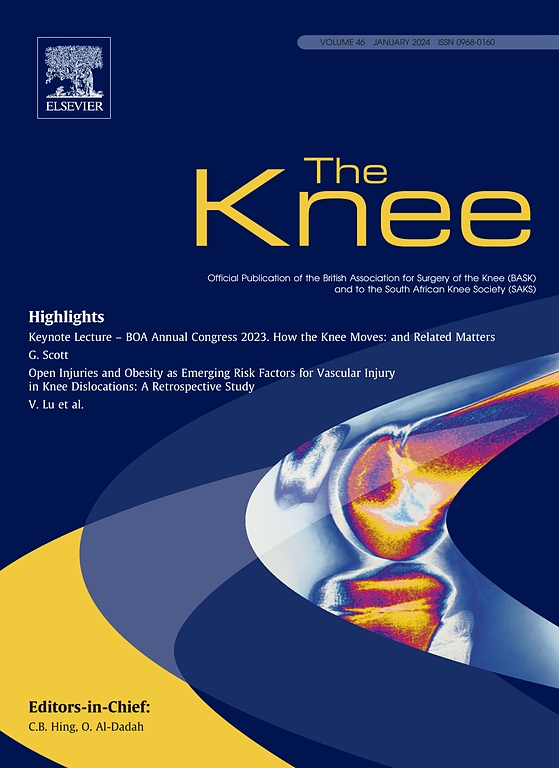
OE Journal. 2013;1(11):42 Knee. 2012 Aug;19(4):352-5. Epub 2011 Jun 1244 patients with end stage osteoarthritis, scheduled to undergo uni-compartmental knee replacement (UKR), were randomized to assess the efficacy of a 24 hour post-operative intra-articular local anaesthetic infusion. Patients either received a 20 ml bolus of 0.5% bupivacaine or a 20 ml bolus of saline. Results over the first 48 hours indicated the anaesthetic injection resulted in a significant decrease in pain and in a greater patient satisfaction than controls, between 24 and 48 hours postoperatively.
Was the allocation sequence adequately generated?
Was allocation adequately concealed?
Blinding Treatment Providers: Was knowledge of the allocated interventions adequately prevented?
Blinding Outcome Assessors: Was knowledge of the allocated interventions adequately prevented?
Blinding Patients: Was knowledge of the allocated interventions adequately prevented?
Was loss to follow-up (missing outcome data) infrequent?
Are reports of the study free of suggestion of selective outcome reporting?
Were outcomes objective, patient-important and assessed in a manner to limit bias (ie. duplicate assessors, Independent assessors)?
Was the sample size sufficiently large to assure a balance of prognosis and sufficiently large number of outcome events?
Was investigator expertise/experience with both treatment and control techniques likely the same (ie.were criteria for surgeon participation/expertise provided)?
Oui = 1
Incertain = 0,5
Non pertinent = 0
Non = 0
L'évaluation des critères de rapport permet d'évaluer la transparence avec laquelle les auteurs rapportent les caractéristiques méthodologiques et les caractéristiques de l'essai dans la publication. L'évaluation est divisée en cinq catégories qui sont présentées ci-dessous.
4/4
Aleatorización
4/4
Medidas de resultado
2/4
Inclusión/Exclusión
4/4
Descripción del tratamiento
2/4
Estadística
Detsky AS, Naylor CD, O'Rourke K, McGeer AJ, L'Abbé KA. J Clin Epidemiol. 1992;45:255-65
L'indice de fragilité est un outil qui aide à l'interprétation des résultats significatifs, en fournissant une mesure de la force d'un résultat. L'indice de fragilité représente le nombre d'événements consécutifs qui doivent être ajoutés à un résultat dichotomique pour que le résultat ne soit plus significatif. Un petit nombre représente un résultat plus faible et un grand nombre un résultat plus fort.
Pourquoi cette étude était-elle nécessaire maintenant ?
Total knee and uni-compartmental knee replacement procedures are associated with considerable post-operative pain. The use of number of peri-operative analgesic regimes have been demonstrated to be effective in reducing the post-operative pain and decreasing the total time until hospital discharge. While these methods appear to be effective in reducing the immediate post-operative pain, recent findings have indicated that an appreciable number of patients suffer pain during the first postoperative day, as the nerve block and local analgesia wear off. This may lead to an increased time until mobilization and subsequently hospital discharge. Local infiltration analgesia early on the first post-operative day may address this increase in pain and improve patient satisfaction while decreasing the length of hospital stay.
Quelle était la principale question de recherche ?
Does the use of intra-articular analgesia administer on the first post-operative day through a catherter inserted into the knee during the operation result in decreased pain and improved patient satisfaction compared to controls, measured over the first 48 postoperative hours?
Quels sont les résultats importants ?
- Over the first post-operative 24 hours, there were no differences in VAS pain scores between the two groups, as well as prior to the injection of the first 24 hours through the intra-articular catheter. (P>0.05)
- VAS pain scores prior to the 24 hours injection were 6.32 +/- 2.01 in group A and 5.15 +/- 2.31 in group C.
- Patients in group A had significantly lower VAS pain scores immediately following the injection after the first 24 hours, (1.8 +/- 1.40 vs 6.1 +/- 1.94 (p<0.001)) and 6 hours following the injection, (2.5 +/- 1.82 vs 5.7 +/- 1.92 (p<0.001))
- Both groups initially reported a high degree of postoperative satisfaction post infiltration. There was a significant difference between the two groups with group A indicating greater satisfaction (p<0.001).
- Requirement for rescue analgesia was similar between groups over the first 24 hours, following infiltration 75% of the control group required rescue analgesia compared to 22% of the anaesthetic group (p<0.001). The mean opiate requirement was also different with the controls requiring 12.1 +/- 9.39 mg and the anaesthetic group requiring 3.6 +/- 7.27 (p<0.01)
- There were no complications reported in any group
De quoi dois-je me souvenir en priorité ?
The use of an intra-articular injection of bupivacaine 24 hours following uni-compartmental knee replacement produces a significant reduction in postoperative pain during the 24 to 48 hour postoperative period and improves patient satisfaction in comparison controls receiving a saline injection.
Comment cela affectera-t-il les soins prodigués à mes patients ?
The use of an intra-articular analgesic infiltration 24 hours postoperatively can significantly reduce patient pain and improve satisfaction. For this reason surgeons should consider it as a possible addition to current analgesic regimes. Additional research should be undertaken to determine if this 24 hour post-operative injection produces a reduction in hospitalization time.

AVIS DE NON-RESPONSABILITÉ
Le contenu de cette page est fourni à titre d'information uniquement et n'est pas destiné à remplacer un avis médical, un diagnostic ou un traitement professionnel. Si vous avez besoin d'un traitement médical, demandez toujours l'avis de votre médecin ou rendez-vous au service des urgences le plus proche. Les opinions, croyances et points de vue exprimés par les individus sur le contenu de cette page ne reflètent pas les opinions, croyances et points de vue d'OrthoEvidence.
0 de 4 articles mensuels GRATUITS débloqués



