




Posterior Femoral Neck Cortex: An Obstacle to Achieving Sagittal Plane Balance in THA?
 Dieser Bericht wurde verifiziert
von einem oder mehreren Autoren der
ursprünglichen Veröffentlichung.
Dieser Bericht wurde verifiziert
von einem oder mehreren Autoren der
ursprünglichen Veröffentlichung.
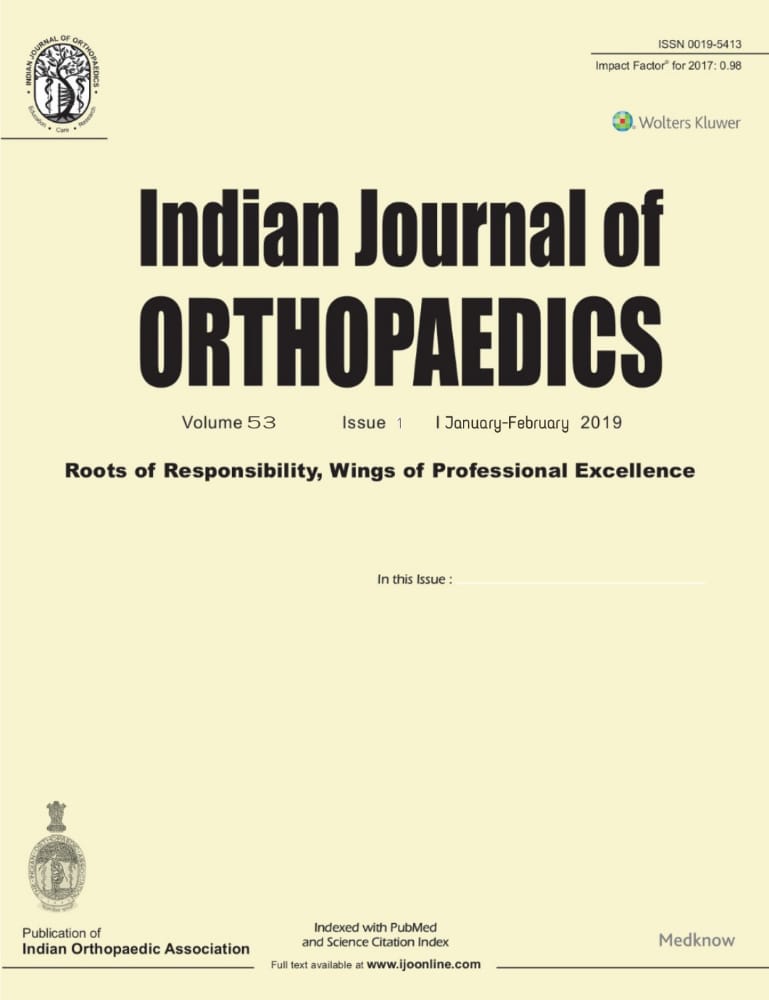
Is Posterior Femoral Neck Cortex an Obstacle in Achieving Sagittal Plane Balance of Uncemented Straight Femoral Stem?
Indian J Orthop . 2023 Aug 4;57(9):1510-1518.60 patients between the ages of 18 and 60 years undergoing primary uncemented total hip arthroplasty (THA) for arthritis secondary to osteonecrosis of the femoral head were included in this prospective randomized controlled trial. Patients were randomized to undergo femoral canal preparation by either the posterior neck cortex trimming method (PNCT; n = 30) or by counter-clockwise rotation of starting awl (CCRA; n = 30). The outcomes of interest included angle of the femoral stem in the coronal and sagittal plane, femoral stem tip deviation in the coronal and sagittal plane, femoral anteversion/retroversion angle, femoral canal preparation time, and blood loss during the procedure. Study findings showed that while there was no significant difference between the groups with respect to coronal plane, the sagittal plane showed significant variation, with the mean angle of the femoral stem and the femoral step tip deviation being significantly lower in the PNCT group. Also, the number of patients with neutral femoral stem angle and femoral stem tip position was significantly higher in the PNCT group. with the CCRA group showing significantly higher posterior positioning for both measurements. However, patients in the CCRA group experienced less blood loss and had a significantly shorter duration of surgery.
Vollständigen ACE-Bericht freischalten
Sie haben Zugang zu 4 weiteren KOSTENLOSEN Artikeln in diesem Monat.
Klicken Sie unten, um diese ACE Reports freizuschalten und anzusehen
Jetzt freischalten
Kritische Beurteilungen der neuesten, hochwirksamen randomisierten kontrollierten Studien und systematischen Übersichten in der Orthopädie
Zugang zu OrthoEvidence-Podcast-Inhalten, einschließlich Kooperationen mit dem Journal of Bone and Joint Surgery, Interviews mit international anerkannten Chirurgen und Diskussionsrunden zu orthopädischen Neuigkeiten und Themen
Abonnement von The Pulse, einem zweimal wöchentlich erscheinenden evidenzbasierten Newsletter, der Ihnen helfen soll, bessere klinische Entscheidungen zu treffen
Exklusiver Zugang zu Originalartikeln, einschließlich eigener systematischer Übersichten, sowie zu Artikeln über Methoden der Gesundheitsforschung und aktuelle orthopädische Themen
Oder upgraden Sie noch heute und erhalten Sie Zugang zu allen OrthoEvidence-Inhalten für nur $1,99 pro Woche.
Sie haben bereits ein Konto? Einloggen


0 von 4 monatliche KOSTENLOSE Artikel freigeschaltet


