










TRAUMA
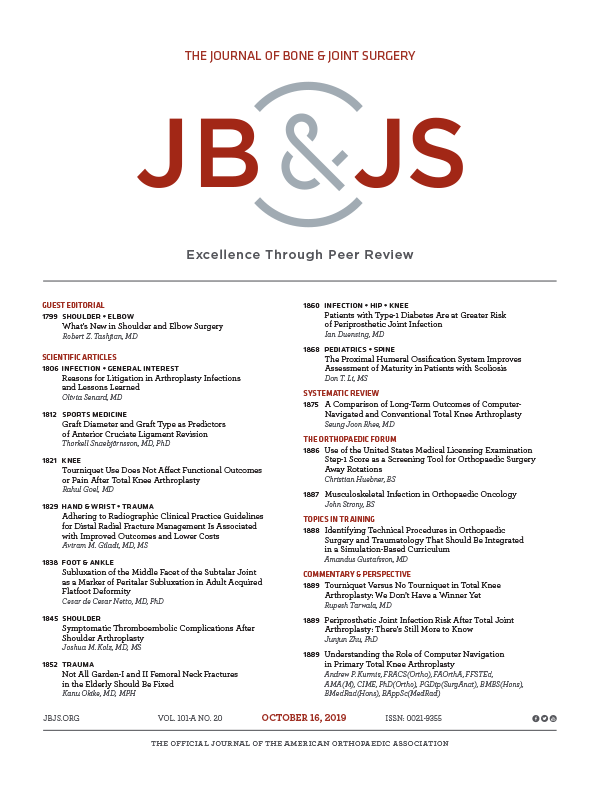
A Comparison of the Effect of One, Three, or Six Weeks of Immobilization on Function and Pain After Open Reduction and Internal Fixation of Distal Radial Fractures in Adults: A Randomized Controlled Trial
 Diese Studie wurde als potenziell hochrangig eingestuft.
Die KI-gesteuerte High-Impact-Metrik von OE schätzt den Einfluss ein, den eine Arbeit wahrscheinlich haben wird, indem sie Signale sowohl aus der Zeitschrift, in der sie veröffentlicht wurde, als auch aus dem wissenschaftlichen Inhalt des Artikels selbst integriert.
Das mit Hilfe modernster natürlicher Sprachverarbeitung entwickelte OE High Impact-Modell sagt die zukünftige Zitationsleistung einer Studie genauer voraus als der Impact-Faktor einer Zeitschrift allein.
Dies ermöglicht eine frühere Erkennung von klinisch bedeutsamer Forschung und hilft den Lesern, sich auf Artikel zu konzentrieren, die die zukünftige Praxis am ehesten beeinflussen werden.
Diese Studie wurde als potenziell hochrangig eingestuft.
Die KI-gesteuerte High-Impact-Metrik von OE schätzt den Einfluss ein, den eine Arbeit wahrscheinlich haben wird, indem sie Signale sowohl aus der Zeitschrift, in der sie veröffentlicht wurde, als auch aus dem wissenschaftlichen Inhalt des Artikels selbst integriert.
Das mit Hilfe modernster natürlicher Sprachverarbeitung entwickelte OE High Impact-Modell sagt die zukünftige Zitationsleistung einer Studie genauer voraus als der Impact-Faktor einer Zeitschrift allein.
Dies ermöglicht eine frühere Erkennung von klinisch bedeutsamer Forschung und hilft den Lesern, sich auf Artikel zu konzentrieren, die die zukünftige Praxis am ehesten beeinflussen werden.
OrthoEvidence Journal (OE Journal) - ACE Report
OE Journal. 2019;7(4):66 J Bone Joint Surg Am. 2018 Jul 5;100(13):1118-1125. doi: 10.2106/JBJS.17.00912133 patients with a distal radius fracture scheduled for open reduction and internal fixation with a volar plate were randomized to a postoperative immobilization period for 1 week, 3 weeks, or 6 weeks. Primary outcomes included wrist function, pain, and range of motion in wrist extension and forearm supination. Follow-up was performed at 6 weeks, 12 weeks, and 26 weeks postoperatively. Results demonstrated significantly better results related to the Patient-Rated Wrist Evaluation, visual analog scales for pain, and active range of wrist extension at 6 weeks for patients allocated to immobilization for only 1 or 3 weeks as compared to patients allocated to immobilization for 6 weeks. Differences between the three groups for results at 12 and 26 weeks were not statistically significant. Loss of fracture position over follow-up was more frequent among patients allocated with 1-week immobilization (n=4) as compared to 3-week (n=0) or 6-week (n=1) immobilization, although the difference was not statistically significant.
Vollständigen ACE-Bericht freischalten
Sie haben Zugang zu 4 weiteren KOSTENLOSEN Artikeln in diesem Monat.
Klicken Sie unten, um diese ACE Reports freizuschalten und anzusehen
Jetzt freischalten
Kritische Beurteilungen der neuesten, hochwirksamen randomisierten kontrollierten Studien und systematischen Übersichten in der Orthopädie
Zugang zu OrthoEvidence-Podcast-Inhalten, einschließlich Kooperationen mit dem Journal of Bone and Joint Surgery, Interviews mit international anerkannten Chirurgen und Diskussionsrunden zu orthopädischen Neuigkeiten und Themen
Abonnement von The Pulse, einem zweimal wöchentlich erscheinenden evidenzbasierten Newsletter, der Ihnen helfen soll, bessere klinische Entscheidungen zu treffen
Exklusiver Zugang zu Originalartikeln, einschließlich eigener systematischer Übersichten, sowie zu Artikeln über Methoden der Gesundheitsforschung und aktuelle orthopädische Themen
Oder upgraden Sie noch heute und erhalten Sie Zugang zu allen OrthoEvidence-Inhalten für nur $1,99 pro Woche.
Sie haben bereits ein Konto? Einloggen
Gehören Sie zu einem unserer Partnerverbände?
Klicken Sie hier, um im Rahmen Ihrer Verbandsmitgliedschaft kostenlosen Zugang zu erhalten!


0 von 4 monatliche KOSTENLOSE Artikel freigeschaltet



